
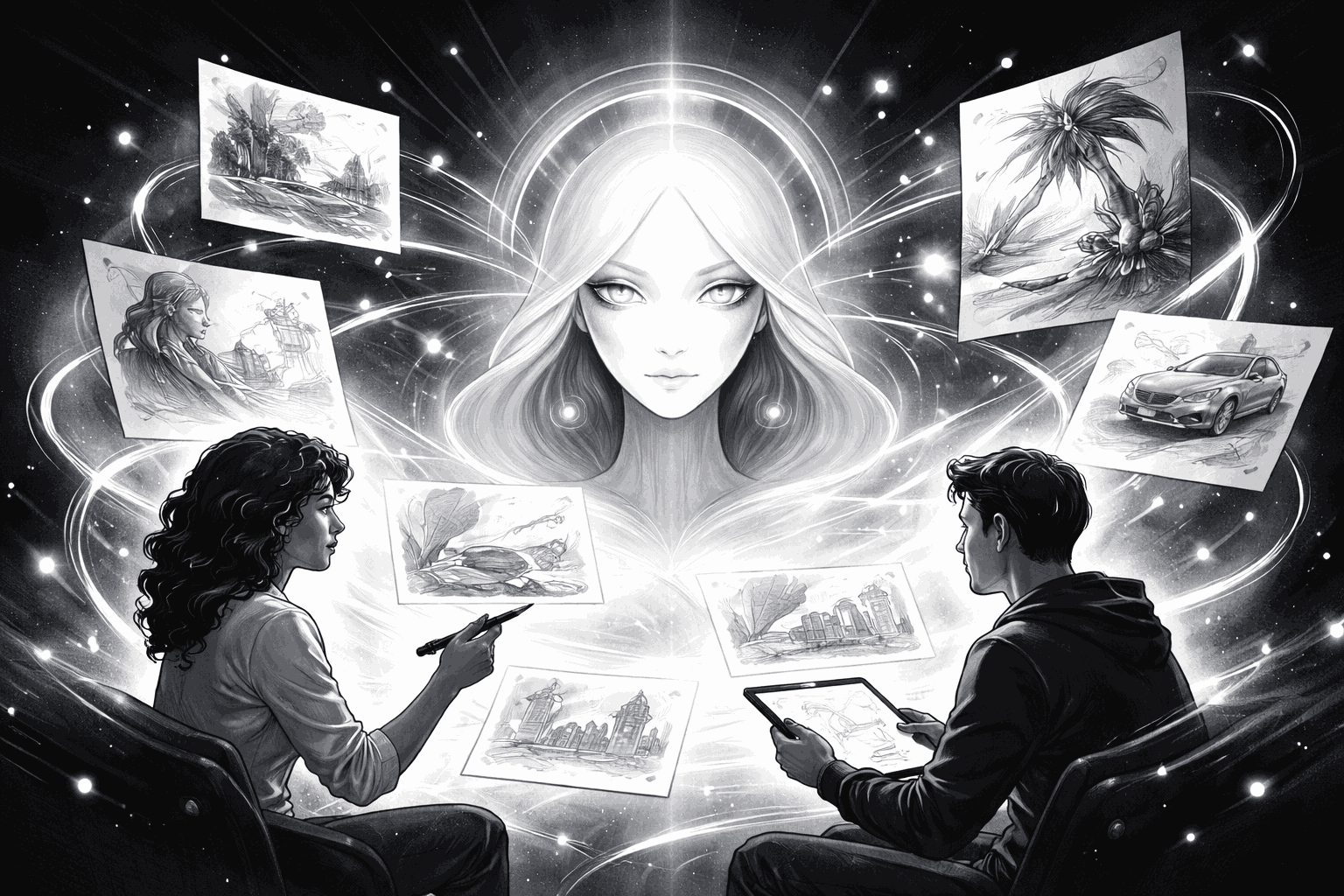
Awen: Turning Ideas Into Visuals With AI
In an era where artificial intelligence has rapidly transformed creative workflows, a new startup called Awen is rethinking how humans and machines collaborate. Founded in 2023 and backed by Y Combinator as part of the Winter 2025 batch, Awen is positioning itself as a creative partner rather than just another tool.
The premise is simple but powerful: instead of forcing creatives to adapt to technical systems, Awen adapts to the way creatives naturally think and work. Through conversation, it translates human intent into high-quality visuals—removing the need for complex prompts, parameter tuning, or technical workflows.
This shift is more than a product feature. It reflects a deeper philosophical stance on creativity in the age of AI: that technology should amplify imagination, not constrain it.
Why Have AI Creative Tools Become So Complex?
Over the past few years, AI-powered creative tools have evolved at an astonishing pace. Platforms capable of generating images, videos, and designs from text have become widely accessible. However, this rapid progress has come with an unintended consequence—complexity.
Most modern AI tools require users to:
- Craft precise prompts
- Adjust multiple parameters
- Understand technical structures like node graphs
- Iterate through trial-and-error workflows
For many creatives, this represents a fundamental shift in how they are expected to work. Instead of focusing on ideas, they must first learn how to “speak machine.”
This creates friction. Designers, artists, and creative professionals are often forced into hybrid roles where engineering skills become just as important as artistic ones. While some embrace this, many find it disrupts their natural creative process.
Awen identifies this gap as its core opportunity.
What Problem Is Awen Trying to Solve?
At its heart, Awen addresses a simple but critical issue: creative work does not begin with technical inputs—it begins with ideas.
Traditional AI tools often assume that users know exactly what they want and how to describe it in structured, optimized language. But in reality, creativity is rarely linear. It is exploratory, iterative, and often ambiguous.
Awen recognizes that:
- Ideas evolve through dialogue
- Direction emerges gradually
- Creativity thrives on iteration and feedback
By focusing on conversation instead of commands, Awen removes the burden of precision at the early stages of creation. Users no longer need to “engineer” their thoughts into prompts. Instead, they can express intent naturally and refine it through interaction.
This approach aligns more closely with how creative professionals actually work.
How Does Awen Turn Conversation Into Visual Output?
Awen’s defining feature is its conversational interface. Rather than relying on static inputs, it engages users in a dynamic exchange that gradually refines their vision.
The process typically unfolds as follows:
- Initial Intent
The user describes an idea loosely—without worrying about technical accuracy. - Exploration
Awen responds with interpretations, suggestions, or visual drafts. - Iteration
The user provides feedback, clarifies direction, or explores alternatives. - Refinement
Through multiple exchanges, the output becomes increasingly aligned with the user’s vision.
This mirrors the way creatives collaborate with human partners—art directors, designers, or clients. Instead of a one-shot output, the process becomes a dialogue.
The result is not just faster production, but a more intuitive and human-centered workflow.
Who Is Behind Awen’s Vision?
Awen was founded by Thibault Henriet, whose background uniquely positions him at the intersection of creativity and operations.
Before launching Awen, Henriet served as Head of Operations France at Moda Operandi, where he oversaw creative processes at scale. His earlier experience included working directly with contemporary artists, supporting production across industries such as:
- Advertising
- Cinema
- Fashion
- Design
- Music
- Publishing
This exposure gave him a deep understanding of how creative work actually happens—far removed from rigid, technical workflows.
Notably, Henriet received an O1 visa in visual arts at just 21 years old, highlighting his early recognition in the creative field. He is also an alumnus of Sciences Po, further reinforcing his multidisciplinary perspective.
This combination of artistic sensibility and operational expertise is clearly reflected in Awen’s product philosophy.
How Is Awen Different From Other AI Creative Tools?
The AI creative space is crowded, with numerous platforms offering image generation and design automation. However, Awen distinguishes itself in several key ways.
1. Conversation Over Commands
Most tools rely on structured prompts. Awen relies on dialogue.
2. Intent Over Precision
Instead of requiring exact inputs, Awen interprets broader intent.
3. Process Over Output
Rather than focusing solely on final results, Awen emphasizes the creative journey.
4. Accessibility Over Expertise
Users do not need technical knowledge to produce high-quality visuals.
This positioning transforms Awen from a tool into a collaborator. It is not just executing instructions—it is participating in the creative process.
Why Does Conversation Matter in Creative Work?
Conversation is a fundamental part of creativity. Whether working with clients, teams, or collaborators, creatives rarely operate in isolation.
Dialogue enables:
- Idea refinement
- Perspective shifts
- Iterative improvement
- Emotional and aesthetic alignment
By embedding conversation into its core functionality, Awen taps into this natural dynamic. It reduces the cognitive load associated with technical inputs and allows users to stay focused on what truly matters—their ideas.
This is particularly important in early-stage ideation, where clarity is often lacking and exploration is essential.
What Industries Could Benefit From Awen?
Awen’s approach has broad applicability across industries that rely on visual output and creative exploration.
Design & Branding
Designers can rapidly explore visual directions without crafting complex prompts.
Marketing & Advertising
Teams can generate campaign visuals aligned with evolving concepts.
Fashion
Creative professionals can iterate on styles and concepts conversationally.
Media & Entertainment
Storyboarding, concept art, and visual development become more fluid.
Freelance & Independent Creators
Individuals gain access to high-level creative support without technical barriers.
In each case, the value lies not just in speed, but in creative freedom.
What Does Awen’s Approach Say About the Future of AI?
Awen reflects a broader shift in how AI products are being designed. The early wave of AI tools prioritized capability—what machines could do. The next wave is focusing on usability—how humans interact with those capabilities.
This transition includes:
- Moving from technical interfaces to natural language
- Prioritizing user experience over raw functionality
- Designing systems that adapt to human behavior
Awen embodies this shift by treating AI as a partner rather than a tool.
If successful, it could signal a new standard for creative software—one where technology fades into the background and creativity takes center stage.
Can AI Truly Become a Creative Partner?
The idea of AI as a “creative partner” raises important questions. Can a machine truly collaborate? Can it understand nuance, taste, or emotion?
Awen does not claim to replace human creativity. Instead, it enhances it by:
- Accelerating exploration
- Reducing friction
- Providing instant feedback
In this sense, Awen acts more like an extension of the creative mind than a replacement for it.
The partnership is not about autonomy, but augmentation.
What Challenges Might Awen Face?
Despite its promising vision, Awen operates in a highly competitive and rapidly evolving space. Key challenges may include:
- Differentiating itself from established AI tools
- Maintaining quality and consistency in outputs
- Scaling conversational intelligence effectively
- Educating users on a new way of working
Additionally, as AI becomes more ubiquitous, user expectations will continue to rise. Delivering a seamless and intuitive experience will be critical.
What Is the Long-Term Vision for Awen?
Awen’s long-term ambition appears to extend beyond visual generation. By establishing conversation as the primary interface, it opens the door to a broader range of creative applications.
Potential future directions could include:
- Multi-modal creativity (video, audio, 3D)
- Deeper personalization based on user style
- Integration into existing creative workflows
- Collaboration features for teams
Ultimately, Awen aims to redefine how creative work is initiated, developed, and completed.
Why Is Awen a Startup to Watch?
In a crowded AI landscape, Awen stands out not because of what it builds, but how it builds it. Its focus on conversation, intent, and human-centered design addresses a fundamental gap in current tools.
By removing technical barriers and embracing the natural flow of creativity, Awen offers a glimpse into a future where AI feels less like software—and more like a collaborator.
As creative industries continue to evolve, startups like Awen will play a crucial role in shaping the tools that define the next generation of work.