
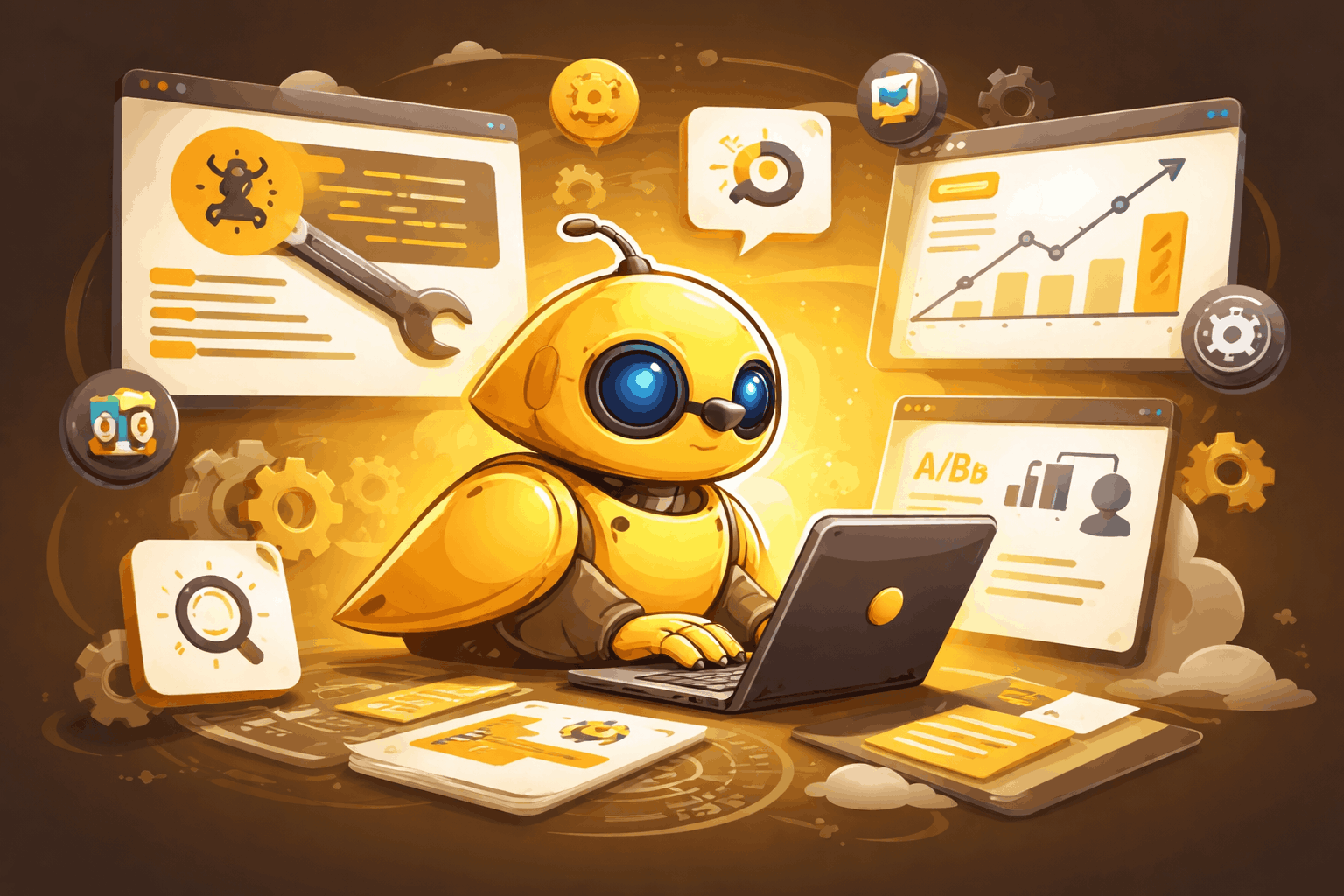
CodeCanary: Smarter Debugging with AI
In the modern digital economy, where every click, scroll, and interaction can influence revenue, product teams face an overwhelming challenge: understanding user behavior deeply enough to continuously improve their applications. Into this landscape steps CodeCanary — a startup founded in 2022 and based in San Francisco — with a bold ambition to redefine how software products are monitored, improved, and optimized.
CodeCanary positions itself not merely as a tool, but as an AI product engineer — an autonomous system that proactively identifies issues, suggests improvements, and even implements solutions. Unlike traditional analytics platforms that require manual interpretation and action, CodeCanary operates continuously, bridging the gap between insights and execution.
The significance of this approach lies in its ability to eliminate bottlenecks in product development workflows, enabling teams to focus less on diagnosing problems and more on strategic innovation. With only a small founding team, CodeCanary exemplifies how AI-native startups can punch far above their weight.
Who Are the Minds Behind CodeCanary?
Every transformative startup begins with a vision, and CodeCanary is no exception. The company was co-founded by Michael Egan and Brendan Ashworth.
Michael Egan brings entrepreneurial leadership and product intuition to the company, shaping its mission and direction. Brendan Ashworth, on the other hand, contributes deep technical expertise. Having studied physics and artificial intelligence at Massachusetts Institute of Technology, Ashworth combines academic rigor with real-world engineering experience, including work at IBM and involvement with the Node.js Core Team.
Together, they represent a blend of technical depth and product vision, which is critical for building a system as ambitious as an autonomous AI engineer. Their backgrounds suggest a strong understanding not only of how software is built, but also of how it fails — and how those failures can be systematically addressed.
What Problem Is CodeCanary Trying to Solve?
Modern software products generate an enormous volume of data through analytics platforms, user sessions, and behavioral tracking tools. However, this abundance of data creates a paradox: more information does not necessarily lead to better decisions.
Product teams often rely on tools like Slack, GitHub, and PostHog to manage workflows, codebases, and analytics. While these tools are powerful individually, they require human effort to connect the dots between user behavior and product improvements.
The core problem is time and attention. There simply are not enough hours in the day for teams to:
- Watch every session replay
- Identify every bug encountered by users
- Analyze every conversion drop-off
- Run and monitor experiments continuously
As a result, many opportunities for improvement are missed, and critical issues may go unresolved longer than they should.
CodeCanary addresses this gap by acting as a persistent, intelligent observer — one that not only detects problems but actively works to resolve them.
How Does CodeCanary Use AI to Transform Product Engineering?
At the heart of CodeCanary’s innovation is its ability to connect coding agents with product analytics, creating a feedback loop that is both autonomous and actionable.
Rather than treating analytics as a passive source of insights, CodeCanary turns it into a driver of automated development activity. The system continuously monitors user sessions and product interactions, identifying patterns that indicate bugs, friction points, or opportunities for optimization.
Once an issue is detected, CodeCanary does not stop at reporting it. Instead, it:
- Investigates the root cause in the codebase
- Generates a solution
- Submits a pull request (PR) directly to the development workflow
This end-to-end capability effectively transforms CodeCanary into a self-operating engineer, capable of moving from observation to implementation without human intervention.
The integration with platforms like Slack ensures that teams remain informed and in control, while still benefiting from automation.
Can AI Really Find and Fix Bugs Automatically?
One of CodeCanary’s most compelling features is its ability to detect and resolve bugs using session replays. Session replays provide a detailed record of how users interact with a product, capturing not just what happens, but how it happens.
CodeCanary leverages this data to:
- Identify when users encounter errors or unexpected behavior
- Trace those issues back to specific parts of the codebase
- Generate fixes and propose them as pull requests
This approach represents a significant evolution from traditional debugging methods, which often rely on logs, error reports, or user feedback. By contrast, CodeCanary operates proactively, identifying issues before they escalate into widespread problems.
Moreover, the system can determine which users were impacted, providing valuable context for prioritization and communication.
How Does CodeCanary Improve Conversion Rates?
Beyond bug fixing, CodeCanary also focuses on growth optimization, particularly in the area of conversion rates. In digital products, even small improvements in conversion can lead to substantial revenue gains.
CodeCanary identifies bottlenecks in user journeys — points where users drop off or fail to complete desired actions. It then takes a bold step: designing and implementing experiments automatically.
The platform can:
- Create A/B test variants
- Submit these variants as pull requests
- Run low-risk experiments autonomously on live environments
This capability transforms experimentation from a manual, resource-intensive process into a continuous, automated workflow. Teams no longer need to wait for dedicated growth sprints or allocate significant engineering time to test hypotheses.
Instead, CodeCanary ensures that experimentation is always happening in the background, steadily improving product performance.
What Role Does Automation Play in Product Insights?
Another key aspect of CodeCanary’s offering is its ability to provide on-demand insights into product performance and user behavior.
Teams can ask complex questions such as:
- How did a specific experiment perform across different devices?
- Which user segments are most engaged?
- What behaviors correlate with successful conversions?
CodeCanary processes these queries using its integrated analytics and AI capabilities, delivering answers quickly and accurately.
Additionally, the platform tracks high-value prospects and customers, helping businesses focus their efforts on the most impactful users. This is particularly valuable for SaaS companies and startups that rely on efficient customer acquisition and retention strategies.
How Does CodeCanary Fit Into Existing Workflows?
One of the reasons CodeCanary stands out is its seamless integration into tools that teams already use daily. By connecting directly to Slack, GitHub, and PostHog, it minimizes friction and accelerates adoption.
Instead of introducing yet another dashboard or interface, CodeCanary embeds itself within existing workflows. For example:
- Notifications and updates appear in Slack
- Code changes are managed through GitHub pull requests
- Analytics are sourced from PostHog
This approach ensures that teams can leverage AI capabilities without disrupting their привычні процеси. It also reinforces the idea that CodeCanary is not just a tool, but a collaborative team member.
What Makes CodeCanary Different From Traditional Tools?
The key differentiator of CodeCanary lies in its autonomy. Traditional tools provide insights, but they rely on humans to interpret and act on those insights.
CodeCanary, by contrast, closes the loop:
- It observes user behavior
- It identifies issues and opportunities
- It generates solutions
- It implements those solutions
This end-to-end capability represents a shift toward AI-native product development, where systems are not just assistants but active contributors.
Furthermore, CodeCanary’s ability to operate continuously ensures that no opportunity is overlooked. It works around the clock, analyzing data, running experiments, and improving the product.
What Is the Future Vision for CodeCanary?
As AI continues to evolve, the concept of an “AI product engineer” is likely to become increasingly sophisticated. CodeCanary’s current capabilities already hint at a future where:
- Product optimization is fully automated
- Bugs are resolved before users notice them
- Experiments run continuously without human oversight
- Insights are generated in real time
In this vision, human teams focus on strategy, creativity, and high-level decision-making, while AI handles execution and optimization.
For CodeCanary, the next steps may involve expanding integrations, improving model accuracy, and scaling its capabilities to support larger and more complex systems.
Why Does CodeCanary Represent a Shift in Software Development?
Ultimately, CodeCanary represents more than just a new tool — it embodies a paradigm shift in how software is built and maintained.
By combining AI, analytics, and automation, it challenges the traditional boundaries between development, product management, and data analysis. It suggests a future where these disciplines converge into a single, intelligent system capable of managing the entire product lifecycle.
For startups and enterprises alike, this approach offers a compelling promise: faster iteration, better user experiences, and more efficient use of resources.
In a world where speed and precision are critical, CodeCanary’s vision of an autonomous AI product engineer may well become the new standard for digital product development.