
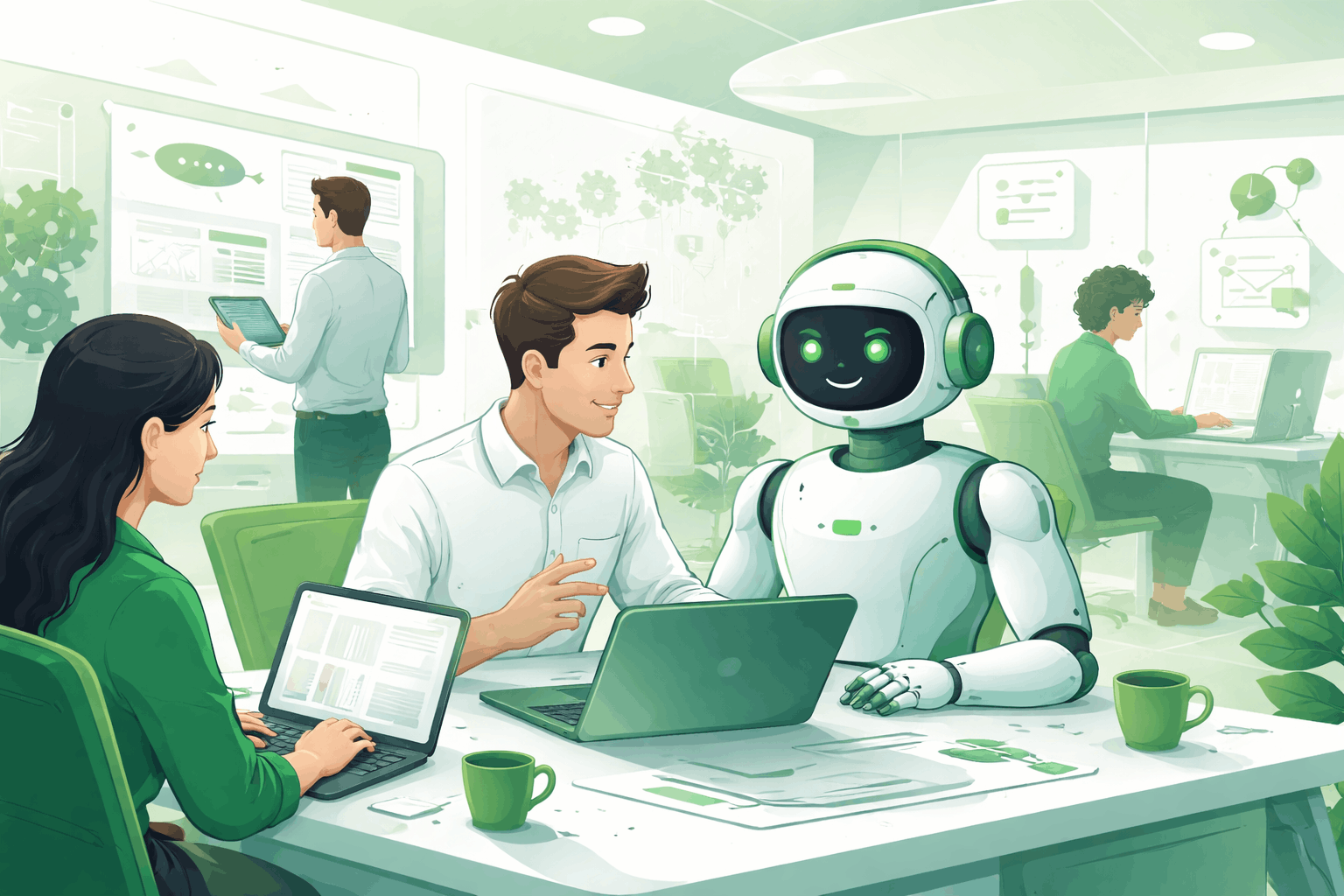
Hire AI, Not APIs: Inside Unify’s Vision
In a world where artificial intelligence tools are rapidly becoming part of everyday workflows, one startup is challenging the very foundation of how people interact with machines. Unify positions itself not as another automation tool, but as a creator of something far more human-like: virtual colleagues.
Founded in 2022 and based in London, Unify is building AI teammates that can be onboarded, trained, and collaborated with just like real employees. Rather than relying on rigid prompts or predefined workflows, the company introduces a radically different paradigm: “Hire AI — Not APIs.”
At the core of this vision is the belief that work is inherently messy, contextual, and iterative — and that traditional AI tools fail precisely because they attempt to oversimplify it. Unify’s approach reframes AI from a static tool into a dynamic, evolving participant in the workplace.
Who Is Behind Unify and What Drives Its Vision?
Unify was founded by Daniel Lenton, a technologist with a PhD in machine learning for 3D vision and robotics from Imperial College London. His background reflects a deep technical understanding of how intelligent systems perceive, learn, and adapt — a foundation that directly informs Unify’s product philosophy.
Lenton’s approach is rooted in curiosity and engineering depth. Rather than building on top of existing frameworks, the team spent nearly a year developing a custom technology stack from scratch. This decision underscores a key principle: existing architectures were simply not designed to replicate the nuance of human collaboration.
With a compact but focused team of 10 people, Unify operates with startup agility while tackling one of the most complex challenges in AI — making machines behave less like tools and more like coworkers.
Why Do Traditional AI Tools Fall Short in Real Work Environments?
To understand Unify’s innovation, it is essential to examine the limitations of current AI systems.
Most modern AI tools operate on a “prompt-then-execute” model. Users are expected to define a task completely upfront, often in a single instruction. While this works for simple or well-defined tasks, it quickly breaks down in real-world scenarios.
Work, especially in operations-heavy environments, rarely follows a linear script. It involves ambiguity, evolving requirements, and constant decision-making. Tasks are refined through conversation, not dictated in a single command.
Additionally, traditional workflow automation tools rely on rigid architectures. These systems require users to predefine every step, leaving little room for adaptation when circumstances change. As a result, they struggle with processes that cannot be easily articulated in advance.
Perhaps most importantly, existing AI agents lack the qualities that make human collaboration effective. They operate in isolated windows, cannot be interrupted mid-task, and fail to incorporate feedback in a natural, ongoing way. This creates a disconnect between how humans work and how AI systems function.
How Does Unify Turn AI Into a Real Teammate?
Unify addresses these challenges by reimagining the onboarding and collaboration process entirely.
Instead of writing detailed prompts, users interact with their virtual teammates as they would with a new hire. This includes sharing screens, sending documents, recording voice notes, or even hopping on live calls. The AI learns not just the task, but the context, preferences, and decision-making patterns behind it.
This onboarding process is inherently flexible. Users can teach in whatever way feels most natural, removing the friction associated with translating complex workflows into rigid instructions.
The experience is designed to feel as though the AI is “in the room.” Unify’s system supports real-time voice interaction, concurrent multitasking, and continuous collaboration. The virtual teammate can operate its own digital environment, perform multiple tasks simultaneously, and synthesize information into reusable knowledge.
Crucially, the system is fully interruptible. Users can pause, redirect, or refine tasks at any point. This mirrors real-world teamwork, where communication is fluid and adjustments are constant.
What Makes Unify’s Technology Fundamentally Different?
At a technical level, Unify distinguishes itself through a deeply integrated and dynamic architecture.
Rather than executing isolated commands, the system operates through a hierarchy of agents capable of managing subtasks, requesting clarification, and responding to user input in real time. This creates a continuous feedback loop between human and machine.
Each interaction contributes to the development of reusable “skills.” These are not static scripts but evolving capabilities that improve with every iteration. Over time, the AI builds a holistic understanding of workflows, allowing it to perform tasks more efficiently and with greater accuracy.
This compounding effect is one of Unify’s most powerful features. Unlike traditional tools that remain static unless manually updated, Unify’s virtual colleagues become progressively more capable with use.
The result is an AI system that does not merely execute instructions but learns how work is actually done.
Can AI Truly Learn Like a Human Employee?
One of the most compelling aspects of Unify’s approach is its emphasis on learning through interaction.
Just as a human employee improves over time, Unify’s virtual teammates continuously refine their understanding. They ask follow-up questions, reflect on previous actions, and adapt based on feedback.
This creates a sense of progression. The AI is not static but evolving — becoming more aligned with the user’s expectations and workflows with each interaction.
The difference becomes evident quickly. By the second or third day of use, the system already demonstrates noticeable improvements, having internalized patterns and built reusable knowledge structures.
While the comparison to human learning is not perfect, the underlying principle is clear: effective automation requires adaptation, not just execution.
Where Is Unify Already Making an Impact?
Although still in its early stages, Unify has already demonstrated tangible value across several industries.
Teams in real estate, finance, and housing have used the platform to streamline complex, day-to-day processes. These are workflows that traditional automation tools struggle with due to their reliance on judgment, context, and iterative refinement.
For example, tasks involving multiple stakeholders, evolving requirements, or ambiguous inputs can now be handled more efficiently. The AI’s ability to learn incrementally allows it to navigate these complexities in ways that static systems cannot.
This early traction suggests a strong product-market fit, particularly in environments where flexibility and adaptability are critical.
What Does the Future of Work Look Like With Virtual Colleagues?
Unify’s vision extends beyond incremental improvements to existing workflows. It points toward a fundamental shift in how work is structured and executed.
In this future, hiring an AI becomes analogous to hiring a human employee. Organizations onboard virtual teammates, train them over time, and integrate them into daily operations. These AI colleagues handle routine tasks, augment decision-making, and free up human workers to focus on higher-value activities.
This model also redefines scalability. Instead of building complex automation pipelines, companies can simply “hire” additional AI teammates and train them as needed.
The implications are significant. Work becomes more fluid, collaboration more seamless, and productivity less constrained by traditional bottlenecks.
Is Unify Redefining the Role of AI in Business?
Ultimately, Unify represents a shift from tool-based AI to relationship-based AI.
Rather than interacting with machines through commands, users engage in ongoing collaboration. The AI is not a passive executor but an active participant — one that learns, adapts, and contributes over time.
This shift challenges long-standing assumptions about automation. It suggests that the future of AI is not about replacing human work but about augmenting it in more natural and intuitive ways.
By focusing on how people actually work — with all its complexity, ambiguity, and nuance — Unify is positioning itself at the forefront of a new generation of AI systems.
As organizations continue to explore the potential of artificial intelligence, solutions like Unify may well define the next chapter — one where AI is not just a tool, but a teammate.