
1Code: Orchestration Layer for Coding Agents
In the rapidly evolving landscape of AI-assisted software development, a new category of tools is emerging—platforms designed not just to help developers write code, but to coordinate entire fleets of autonomous coding agents. One of the most ambitious entrants in this space is 1Code (21st.dev), an orchestration layer for coding agents founded in 2024 and launched as part of the Winter 2026 batch. Built by a compact team of three and headquartered in San Francisco, the startup positions itself as a control panel for AI coding agents, enabling teams to run them in parallel, automate development workflows, and dramatically accelerate software delivery.
The motivation behind 1Code stems from a practical bottleneck experienced by its own founders. As AI coding tools became more powerful—particularly with the release of advanced models capable of handling complex programming tasks autonomously—developers began running multiple agents simultaneously. What started as a productivity boost quickly became operational chaos. Managing parallel agents through command-line interfaces proved inefficient, error-prone, and visually opaque. Terminal tabs multiplied, context was lost, and collisions between agents working on the same codebase became common.
Recognizing that the future of software engineering would involve supervising intelligent agents rather than writing every line manually, the founders set out to build an orchestration layer. Their vision was simple but transformative: if AI agents are the new developers, teams need a manager’s dashboard to coordinate them. Thus, 1Code was born—not as another coding assistant, but as the infrastructure that makes agent-driven development scalable.
Who Are the Founders Behind the Platform?
The leadership behind 1Code brings together deep experience in developer tools, crypto infrastructure, and product design. CEO and co-founder Serafim Korablev is described as one of the first full-time “vibe-coders,” having embraced AI-assisted development as early as October 2023. His background includes co-founding 21st.dev, a UI components registry that attracted over one million users, as well as launching multiple high-impact projects across web development and blockchain ecosystems.
Among his previous ventures were a Next.js web app builder, a Telegram-native memecoin launchpad that achieved a multi-million-dollar exit, and a cross-chain crypto routing protocol that processed $1.5 billion in gross transaction volume. This track record reflects a pattern: identifying emerging technical paradigms early and building tools that enable broader adoption.
Co-founder Sergey Bunas complements this entrepreneurial experience with a background in scaling technology products, including time spent at Deel. Together, the founders had already built nine products within ten months prior to launching 1Code, accumulating over one million users and fifteen thousand GitHub stars. This rapid execution pace mirrors the philosophy behind their new platform—software development should move at the speed of ideas, not manual processes.
How Does 1Code Function as a Control Panel for Coding Agents?
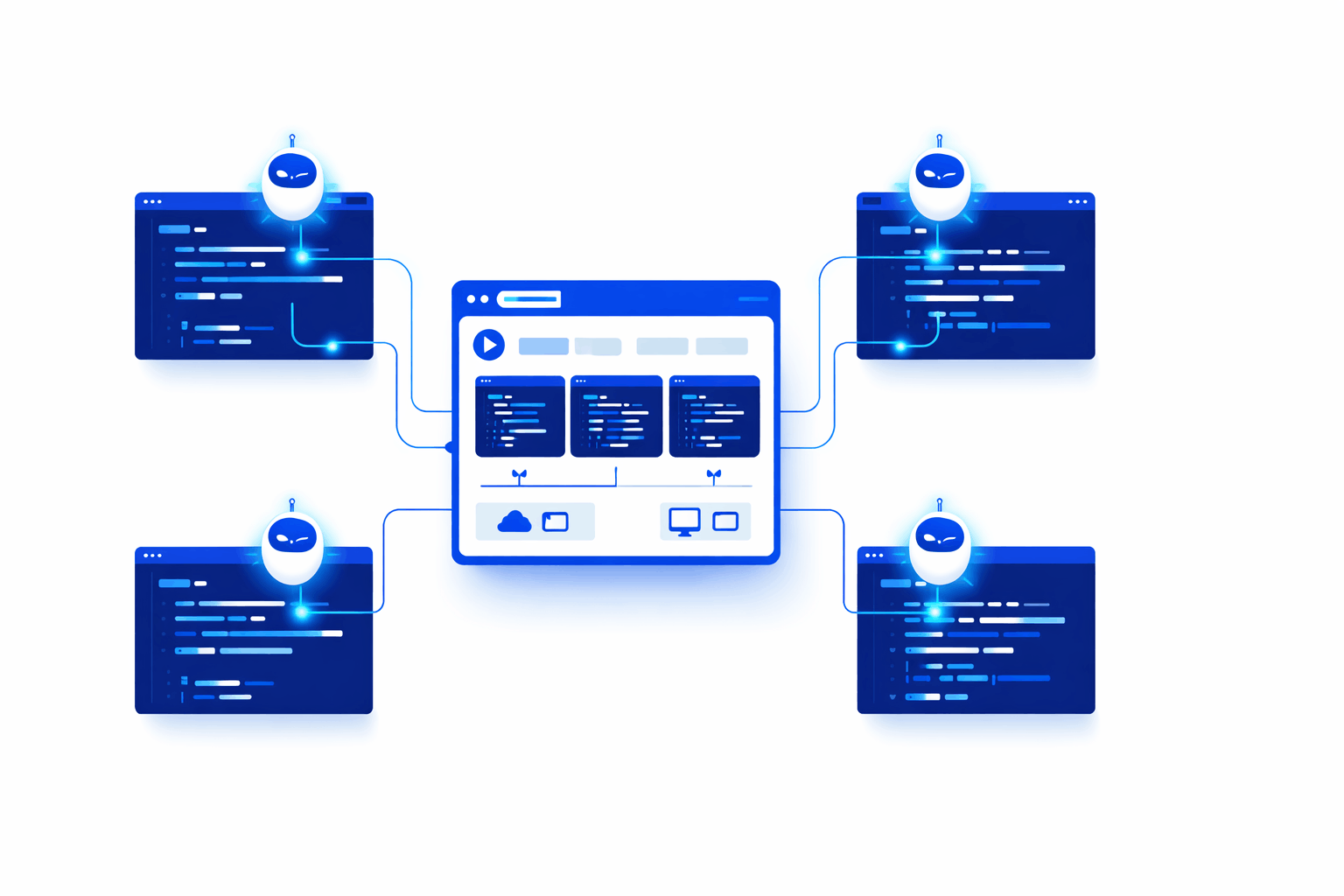
At its core, 1Code is designed as a centralized dashboard that allows teams to run multiple AI coding agents in parallel without interference. Instead of relying on command-line interfaces, developers can observe, manage, and collaborate with agents through a visual environment.
On macOS, the platform enables agents to operate locally, each assigned to its own Git branch to prevent collisions. Developers can monitor up to six agents simultaneously through a split-view interface, watching code changes unfold in real time. Built-in Git tools allow seamless management of commits, pull requests, and diffs without leaving the application. Keyboard shortcuts and workflow optimizations reinforce the sense that the platform is tailored for high-velocity engineering teams.
The web version extends this capability into remote sandboxes hosted in the cloud. Here, agents can run continuously even when the developer’s machine is offline. Live previews allow teams to see application changes as they happen, including mobile interfaces. This persistent execution model reflects a shift from session-based coding to continuous autonomous development, where agents work around the clock.
What Role Do Automations Play in the Platform?
While parallel agent management solves one major problem, the founders quickly discovered that teams wanted more than just oversight—they wanted automation across the entire development lifecycle. This led to the creation of 1Code’s automation layer.
Through integrations with repositories and project management tools, the platform can trigger agents to perform tasks automatically. Pull request reviews are one of the most striking examples. Instead of merely commenting on issues, agents analyze the entire codebase, generate fixes, and push commits directly to the branch. Iteration becomes conversational: tagging the agent prompts further refinement until the code meets standards.
Another automation feature connects task management systems to implementation. When a ticket is assigned, an agent can pick it up, write the code, execute tests, fix failures, and open a pull request once everything passes. This transforms backlog items into executable workflows rather than static to-do lists.
Even continuous integration failures can be addressed autonomously. If a build breaks, the agent reads logs, proposes fixes, reruns tests, and repeats the process until the pipeline turns green or human intervention is required. Importantly, all agent runs are persistent, allowing developers to revisit and continue work later with full context intact.
Why Is an API Layer Essential for Agent Orchestration?
Recognizing that modern development environments rely heavily on integrations, 1Code introduced an API that allows organizations to deploy coding agents programmatically. With a single request, teams can spin up agents in secure remote sandboxes, assign tasks, and receive results without manual setup.
This API approach opens the door to custom workflows. Companies can trigger agents from CI hooks, Slack bots, scheduled jobs, or proprietary systems. Security, sandbox management, updates, and cleanup are handled by the platform, reducing operational overhead.
Customization is another key advantage. Teams can configure what tools and integrations are available inside each sandbox—GitHub CLI, monitoring platforms, knowledge bases, or communication channels. A self-hosted option ensures that organizations with strict compliance requirements can retain control over infrastructure.
In effect, the API transforms coding agents into programmable infrastructure components, similar to cloud compute resources. This abstraction could redefine how engineering organizations allocate work, shifting from assigning tasks to people toward orchestrating intelligent systems.
How Does 1Code Reflect the Future of Software Development?
The emergence of platforms like 1Code signals a broader transition in the industry. For decades, developer productivity improvements focused on better languages, frameworks, and tooling. AI introduces a fundamentally different paradigm: software can now be produced by autonomous agents supervised by humans.
In this context, orchestration becomes the missing layer. Without coordination, multiple agents working simultaneously can create conflicts, redundancy, or inconsistent architecture. A control panel ensures alignment, visibility, and accountability.
1Code’s approach also suggests a new role for developers. Rather than writing every function manually, engineers increasingly act as architects, reviewers, and strategists. They define goals, monitor progress, and intervene when necessary. This shift resembles the evolution from manual manufacturing to automated production lines, where oversight replaced repetitive labor.
Furthermore, the platform’s emphasis on persistence and continuous operation hints at a world where development never truly stops. Agents can refine features overnight, resolve issues before users notice them, and maintain systems proactively.
What Challenges Might the Startup Face?
Despite its promise, 1Code operates in a competitive and rapidly changing environment. Large technology companies and well-funded startups are investing heavily in AI development tools. Differentiation will depend on execution speed, user experience, and ecosystem integration.
Trust is another critical factor. Organizations must feel confident that autonomous agents can modify code safely, respect security boundaries, and align with architectural standards. Transparent controls, auditability, and human override mechanisms will be essential.
There is also the cultural challenge of adoption. Engineering teams accustomed to traditional workflows may hesitate to delegate significant responsibilities to AI. Demonstrating reliability and clear productivity gains will be necessary to overcome skepticism.
Could 1Code Become the Operating System for AI Development?
If the trajectory of AI-driven engineering continues, orchestration platforms could become as indispensable as version control systems are today. By positioning itself as a central hub rather than a niche tool, 1Code aims to occupy this foundational role.
Its combination of local and cloud execution, automation, and programmable interfaces suggests a vision that extends beyond individual teams. Entire organizations could coordinate development through agent orchestration layers, optimizing resource allocation and accelerating innovation cycles.
The founders’ history of building widely adopted developer tools lends credibility to this ambition. Their previous success in attracting large user bases indicates an ability to identify and serve emerging needs before they become mainstream.
What Does the Launch of 1Code Reveal About the AI Era?
Ultimately, the launch of 1Code highlights a pivotal moment in technology. AI is no longer confined to assisting with isolated tasks; it is becoming a collaborative workforce. Managing that workforce requires new infrastructure, new interfaces, and new mental models.
By creating a control panel for coding agents, the startup addresses a problem that many teams are only beginning to recognize. As organizations experiment with autonomous development, the need for coordination will intensify.
Whether 1Code becomes the dominant orchestration layer or one of many competitors, its existence signals that the future of software engineering will be defined not just by smarter machines, but by the systems that allow humans and machines to work together effectively. In that sense, the platform is less a product and more a glimpse into the operating model of tomorrow’s tech industry.