
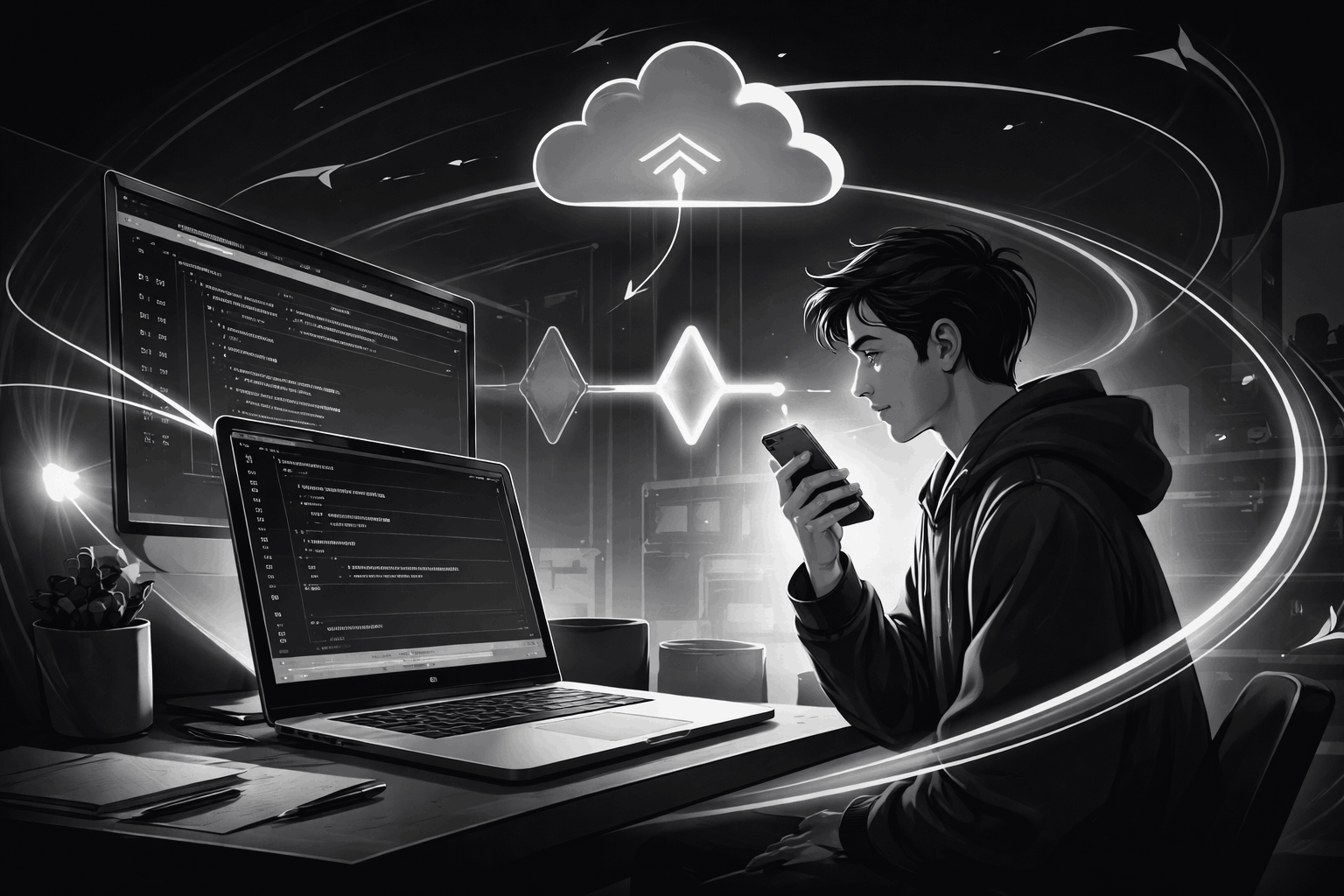
Omnara: Coding with AI Agents From Anywhere
Omnara is a San Francisco–based startup founded in 2025 with a clear and ambitious mission: to make working with AI coding agents continuous, flexible, and truly location-independent. Built as a mobile, web, and voice interface for Claude Code, Omnara allows developers to start a coding session on their desktop and seamlessly continue it from anywhere—on a phone, through a browser, or even via voice commands.
At a time when AI coding agents are increasingly capable of working autonomously, Omnara addresses a subtle but critical bottleneck: human availability. While agents can run for long periods, they still depend on timely clarification, approvals, and feedback from developers. Omnara exists to ensure that this interaction never becomes a blocker, regardless of where the developer happens to be.
Backed by Y Combinator’s Summer 2025 batch and operating with a compact three-person team, Omnara represents a new class of developer tools—ones designed not just for performance, but for real-world human schedules.
What Problem Does Omnara Solve for Modern Developers?
The rise of AI coding agents has transformed how software is built, but it has also exposed new friction points. Agents can generate code, refactor systems, and debug issues autonomously, yet they often pause at critical moments waiting for human input. When that input doesn’t arrive, progress stops.
Developers face several recurring problems. If an agent asks a clarifying question while the developer is commuting or away from their desk, the workflow stalls. If a laptop goes to sleep, long-running tasks may halt entirely. Many existing agent tools also rely on hosted environments, meaning the agent is disconnected from the developer’s real codebase and local setup.
These interruptions create fragility in what should otherwise be a continuous process. Developers end up adapting their schedules around their agents, rather than the other way around. Omnara challenges this imbalance by rethinking how and where human-agent interaction happens.
How Does Omnara Redefine the Way Developers Interact with Claude Code?
At its core, Omnara acts as a command center for Claude Code, extending its reach beyond the desktop. A developer can start an agent locally or in a remote environment they control, then stay connected through Omnara’s web or mobile interface.
The key innovation lies in context preservation. Omnara ensures that full session context—files, history, decisions, and agent state—travels with the developer across devices. Switching from desktop to phone does not mean restarting, re-explaining, or losing momentum.
This continuity fundamentally changes the developer experience. Coding sessions are no longer tied to a single machine or location. Instead, they become persistent conversations that can be resumed anytime, anywhere, without friction.
Why Is Mobile Access to Coding Agents a Game Changer?
Mobile access has traditionally been limited to notifications or passive monitoring in developer workflows. Omnara pushes far beyond that by enabling active participation in coding sessions directly from a phone.
From a practical standpoint, this means developers can review agent output, answer questions, and guide decisions while commuting, traveling, or stepping away from their desk. Rather than waiting hours to respond to a blocking question, they can resolve it in seconds.
This shift is especially valuable for long-running tasks such as refactoring large codebases, running tests, or generating documentation. Instead of pausing overnight or during downtime, agents can keep moving forward with timely human guidance, dramatically reducing cycle times.
How Does Omnara Handle Local and Remote Development Environments?
One of Omnara’s defining principles is that coding agents should run in the developer’s real environment. Unlike many tools that require hosted or abstracted setups, Omnara allows agents to operate directly on the developer’s laptop or on a remote virtual machine they control.
Accessing these agents does not require complex networking setups such as SSH, port forwarding, or tunneling. Omnara provides secure, seamless access to the running agent from anywhere, while preserving the integrity of the environment.
This approach offers a major advantage: the agent works with the same dependencies, configurations, and file structures as the developer. The result is fewer surprises, fewer mismatches, and higher confidence in the generated output.
What Happens When a Developer’s Machine Goes Offline?
One of the most frustrating experiences in AI-assisted development is losing progress when a laptop goes offline. Long-running tasks can fail simply because a machine sleeps or loses connectivity.
Omnara directly addresses this issue by enabling agents to continue running in the cloud when the developer’s machine goes offline. Work does not stop just because the laptop is closed or disconnected.
Developers can still interact with the agent through the web or mobile interface, and when they return to their desk, the session resumes seamlessly. This capability transforms AI agents from fragile processes into resilient collaborators that adapt to real-world conditions.
Why Does Voice Interaction Matter for Coding Agents?
Typing on a mobile device can be limiting, especially for complex explanations or iterative feedback. Omnara introduces voice as a first-class interface, allowing developers to speak naturally with their coding agents.
Voice interaction provides richer context and faster communication, particularly when multitasking or walking. Developers can describe intent, clarify requirements, or review changes conversationally, rather than struggling with small keyboards.
This feature highlights Omnara’s broader philosophy: interaction with AI agents should feel natural and human. By reducing friction in communication, voice helps maintain flow and makes continuous collaboration more intuitive.
Who Are the Founders Behind Omnara?
Omnara was founded by Ishaan Sehgal and Kartik Sarangmath, both of whom bring deep technical and research experience to the company.
Ishaan Sehgal previously worked as an AI infrastructure engineer at Microsoft, where he built and led Kaito, an open-source project focused on AI tooling. His background also includes machine learning work at Windsor, a Y Combinator Winter 2019 company acquired in 2024, as well as an internship at Roblox. He holds a BS and MCS in Computer Science from the University of Illinois Urbana-Champaign.
Kartik Sarangmath brings a strong research-oriented background, having worked at ThirdAI optimizing neural networks for CPU deployment. He completed both his bachelor’s and master’s degrees in Computer Science at Georgia Tech, focusing on computer vision research. His experience includes publishing academic papers and training large multimodal models at Meta AI.
Together, the founders combine practical AI infrastructure expertise with deep research experience, positioning Omnara at the intersection of applied engineering and advanced AI systems.
How Does Omnara Fit Into the Broader AI Agent Ecosystem?
Omnara positions itself as the connective layer between developers and their AI agents. Rather than replacing existing tools, it enhances them by making interaction continuous and resilient.
As AI agents become more autonomous, the human role shifts from constant supervision to strategic guidance. Omnara supports this transition by ensuring that guidance can happen at the right moment, regardless of location or device.
This approach aligns with a broader trend toward agent-centric development workflows, where AI systems operate continuously and humans intervene only when necessary. Omnara ensures that those interventions are timely, efficient, and frictionless.
What Makes Omnara Different From Other Remote Coding Tools?
While many tools offer remote access or hosted coding environments, Omnara stands out by prioritizing continuity and control. Agents run in environments chosen by the developer, not imposed by the platform. Context is preserved across devices, not fragmented.
The addition of voice interaction and cloud failover further differentiates Omnara from traditional remote development solutions. It is not just about accessing code remotely—it is about maintaining momentum in collaboration with AI agents.
By focusing on real developer behavior and constraints, Omnara avoids the rigidity that often plagues productivity tools.
What Does the Future Look Like for Omnara?
As AI agents take on more responsibility in software development, tools like Omnara are likely to become essential infrastructure. The ability to stay connected, provide guidance, and keep work moving regardless of location will define the next generation of developer workflows.
With its early traction, strong technical founding team, and clear product vision, Omnara is well positioned to become a central command center for AI-driven development. Its focus on flexibility, resilience, and human-centric design reflects a deep understanding of how developers actually work.
In a world where coding no longer happens only at a desk, Omnara ensures that progress never has to pause.