
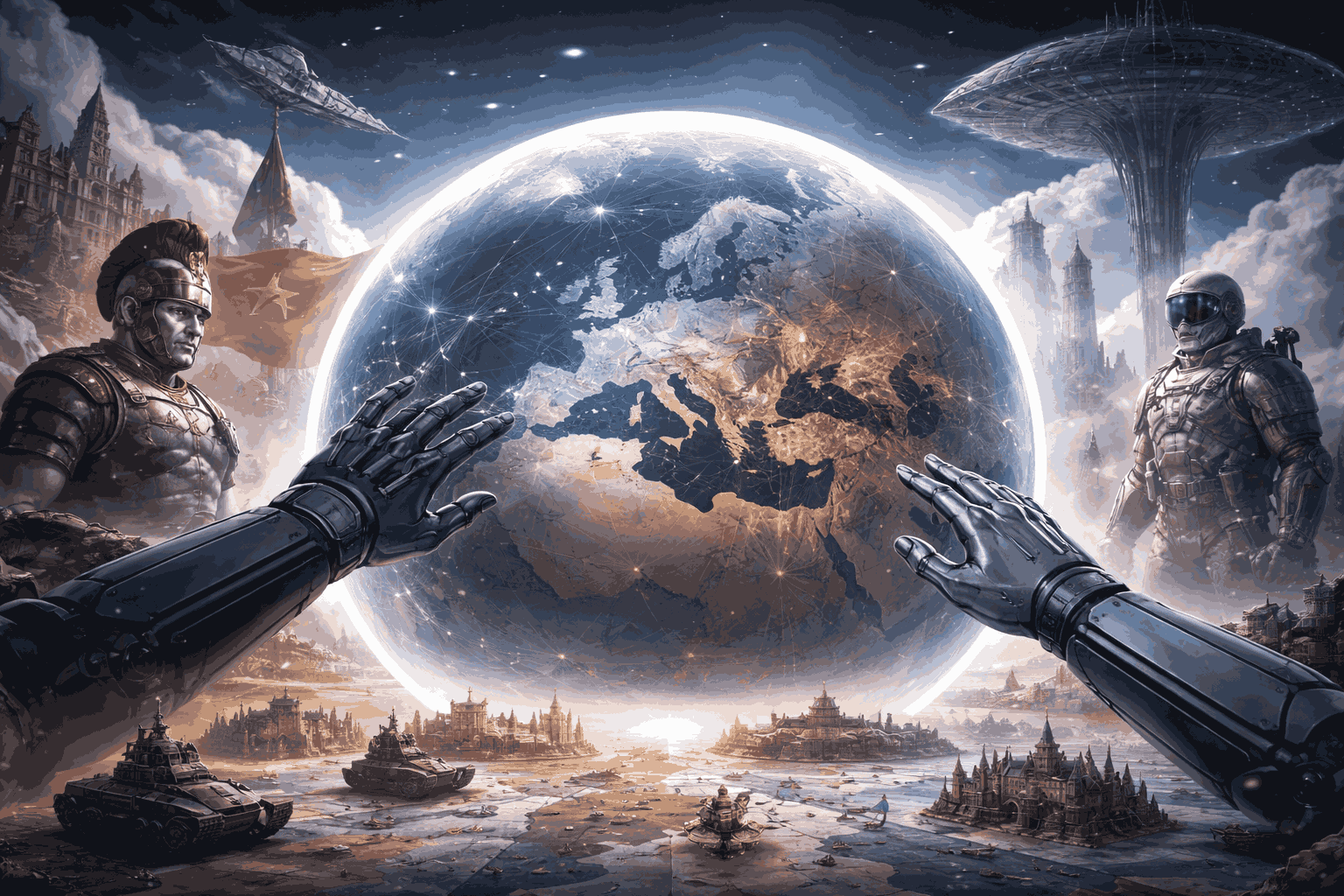
How Pax Historia Uses AI to Rewrite History
Pax Historia is positioning itself as the first AI-powered grand strategy platform, but describing it as just another strategy game would be an understatement. Founded in 2025 and based in San Francisco, Pax Historia blends the creative freedom of sandbox experiences with the systemic depth of traditional grand strategy—then pushes both further using artificial intelligence. The result is not a linear game with fixed outcomes, but a living, reactive world where history, fiction, and imagination collide.
At its core, Pax Historia invites players to ask “what if?”—and then actually play out the answer. What if Rome never fell? What if the Soviet Union survived? What if an alien invasion reshaped Earth’s geopolitics? Instead of scripting these scenarios in advance, the platform allows players to create them, publish them, and watch them evolve dynamically through AI-driven interactions. This approach marks a significant shift from the rigid, rule-based simulations that have defined the grand strategy genre for decades.
How Does Pax Historia Blend History, Fiction, and Imagination?
Pax Historia begins with alternate history but does not stop there. Players can choose a country, a moment in time, and a divergence point, rewriting the course of history from that moment forward. However, the platform also embraces speculative and fictional scenarios that stretch far beyond historical boundaries. Alien invasions, zombie outbreaks, or modern-day geopolitical experiments are not side modes—they are first-class citizens of the platform.
What makes this blend compelling is the consistency of the simulation. Whether the scenario is grounded in ancient Rome or a futuristic global crisis, the same underlying systems govern diplomacy, conflict, and societal change. This allows players to explore wildly different narratives without feeling like they are switching between disconnected game modes. Pax Historia treats imagination not as an exception, but as a design principle.
Why Is AI Central to the Pax Historia Experience?
Artificial intelligence is not an add-on in Pax Historia—it is the engine that makes the experience possible. Traditional grand strategy games rely on pre-designed decision trees and scripted events, which inevitably limit player freedom. Pax Historia replaces those constraints with AI-powered actors that respond dynamically to player actions.
When a player makes a diplomatic move, declares war, or reshapes an economy, other countries and actors respond in contextually appropriate ways. These responses are not pulled from a finite list of outcomes, but generated in real time, allowing the game world to evolve organically. This approach enables emergent storytelling, where no two playthroughs are ever the same, even within the same scenario.
The scale of this system is reflected in the platform’s usage metrics. In a single week, Pax Historia has processed over 100 billion tokens, demonstrating both the technical ambition behind the platform and the intensity of player engagement. AI is not just powering dialogue or flavor text—it is sustaining entire simulated worlds.
How Do Players Create and Share Entire Worlds?
One of Pax Historia’s defining features is its creator-first design. Players are not limited to consuming content; they are encouraged to create it. The platform provides tools to design custom maps, define actors, establish historical context, and set the initial conditions for entire worlds. These creations, known as presets, can then be published to the community and played by anyone.
This creator ecosystem has grown rapidly. Within months, the community has published over 4,000 presets, each receiving at least 50 plays. This volume of user-generated content suggests that Pax Historia is not just a game, but a platform—one where players act as both designers and participants. By lowering the barrier to creation while maintaining depth, Pax Historia empowers users to become world-builders rather than passive players.
What Makes Gameplay Feel Truly Open-Ended?
In Pax Historia, players do not follow predefined missions or victory conditions. Instead, they inhabit a role—such as a country or political group—and make decisions that ripple through time. Players can initiate diplomatic conversations, form alliances, spark conflicts, and even jump forward in time to see the long-term consequences of their actions.
The map itself evolves alongside these decisions. Borders shift, alliances form and dissolve, and the visual state of the world reflects the cumulative impact of player choices. This sense of continuity reinforces the idea that players are shaping history rather than progressing through a checklist of objectives. The absence of rigid narrative rails allows experimentation, failure, and unexpected outcomes to become core parts of the experience.
Why Is Pax Historia Attracting Such a Large Community So Quickly?
In just four months, Pax Historia has organically built a fanbase of tens of thousands of daily active users, with approximately 35,000 players engaging with the platform each day. This growth is particularly notable given the complexity of the genre, which traditionally appeals to a niche audience. Pax Historia’s success suggests that its blend of creativity, accessibility, and depth resonates with a broader player base.
Part of this appeal lies in the social nature of the platform. Presets created by one player become shared experiences for others, fostering a sense of collaboration and collective storytelling. The community does not just play Pax Historia—it expands it. This feedback loop between creators and players fuels engagement and encourages experimentation, turning the platform into a constantly evolving ecosystem.
How Does Pax Historia Differ From Traditional Strategy Games?
Unlike conventional grand strategy titles, Pax Historia does not rely on fixed mechanics alone. While traditional games excel at simulating known systems, they often struggle with unpredictability and player creativity. Pax Historia addresses this limitation by using AI to interpret intent rather than enforce rules rigidly.
This difference fundamentally changes how players interact with the game. Instead of optimizing strategies within a known framework, players are encouraged to test ideas, explore hypotheticals, and see how the world responds. The platform rewards curiosity over mastery, making it appealing not only to strategy veterans but also to players interested in storytelling, history, and speculative thought.
Who Is Behind Pax Historia and What Is Their Vision?
Pax Historia was founded by Eli Bullock-Papa and Ryan Zhang, with Harshita Arora listed as the primary partner. The founding team is small—just three people—but their ambition is anything but. Their vision is to build vastly better tools for creators while delivering richer, more flexible experiences for players.
Rather than focusing solely on content production, the team is investing in systems that scale with the community. By prioritizing creator tools and AI infrastructure, Pax Historia aims to grow alongside its users, allowing the platform to support increasingly complex worlds and narratives over time.
What Does the Future Hold for AI-Driven Strategy Platforms?
Pax Historia represents a broader shift in how games—and interactive experiences more generally—are designed. By combining AI with user-generated content, the platform points toward a future where players are not just consumers, but co-authors of living systems. This approach has implications beyond gaming, touching on education, simulation, and creative collaboration.
As Pax Historia continues to expand its tools and community, it may redefine what players expect from strategy games. The ability to imagine any scenario and see it unfold dynamically could transform the genre, moving it away from static simulations and toward open-ended, player-driven worlds.
Why Does Pax Historia Matter Right Now?
At a time when many games rely on familiar formulas, Pax Historia stands out by embracing uncertainty and imagination. Its success demonstrates a growing appetite for experiences that prioritize creativity over constraint and exploration over optimization. By empowering players to rewrite history—or invent entirely new ones—Pax Historia taps into a timeless human desire to understand how the world works by imagining how it could have been different.
In doing so, Pax Historia is not just building a game. It is building a platform where history, fiction, and artificial intelligence converge, offering players the tools to explore the past, question the present, and invent the future—one scenario at a time.