
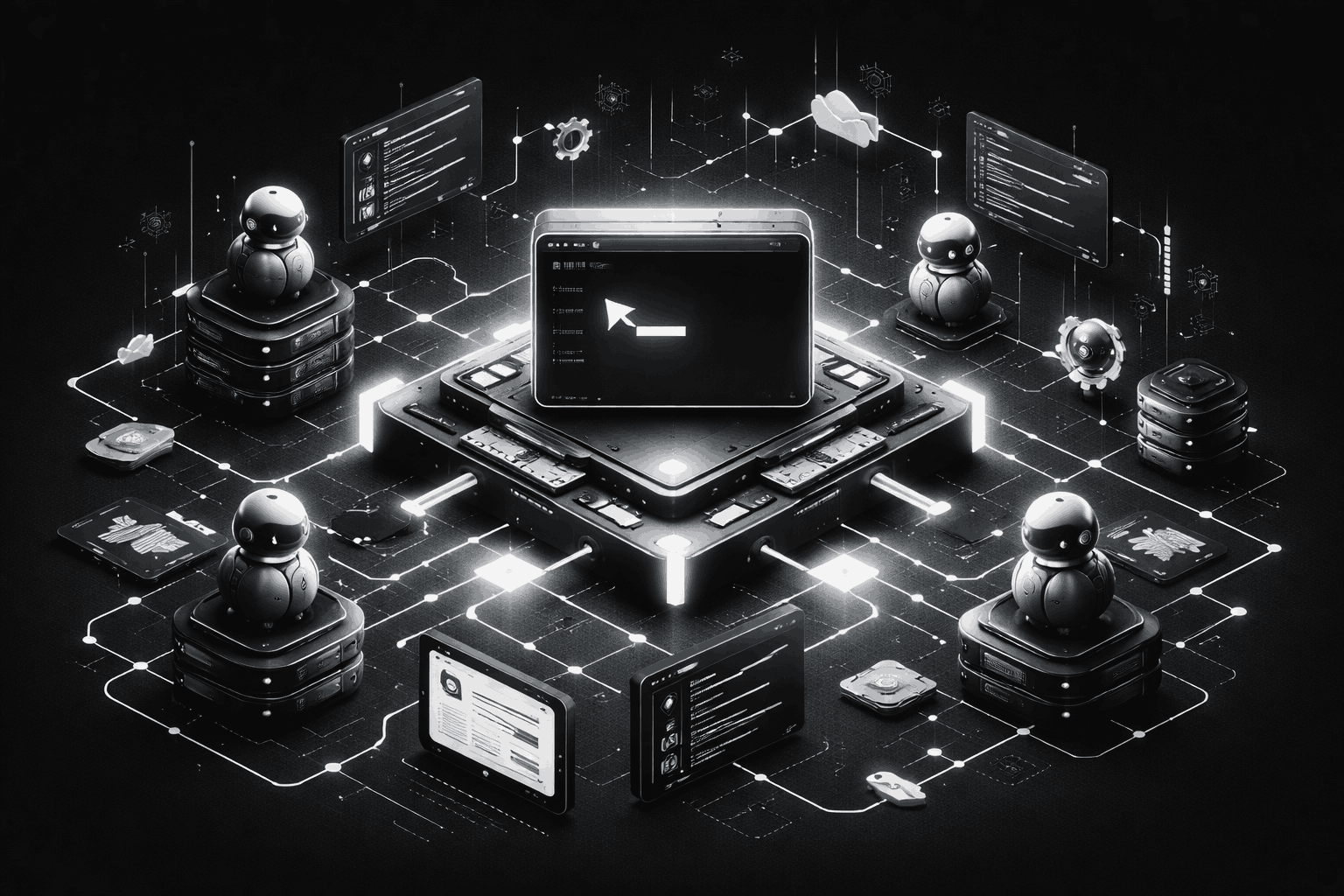
Terminal Use: Infrastructure for AI Agents
In the rapidly evolving landscape of artificial intelligence, a new category of infrastructure is beginning to take shape—platforms designed not for humans, but for agents. Terminal Use, a Winter 2026 Y Combinator startup based in San Francisco, sits at the center of this shift. Positioned as “Vercel for background agents,” the company is building orchestration infrastructure for a future where autonomous software entities continuously operate behind the scenes.
Terminal Use focuses specifically on long-running background agents—AI systems that execute tasks asynchronously, often interacting with filesystems, external tools, and complex workflows without direct human supervision. While much of the recent AI boom has revolved around chat interfaces and real-time copilots, Terminal Use is betting that the real economic value will come from agents that quietly run in production environments: monitoring systems, processing data, generating code, managing infrastructure, and iterating on themselves.
The timing of the startup’s emergence is no coincidence. Over the past year, engineering teams experimenting with agentic applications have encountered a common bottleneck: deploying and maintaining agents at scale is significantly harder than building them. Models have improved dramatically, but production infrastructure has lagged behind. Terminal Use was founded on the belief that agent apps will not win based on model quality alone—they will win on the strength of their orchestration harness.
Why Are Background Agents So Difficult to Deploy?
Despite the excitement surrounding autonomous agents, real-world deployment remains messy and fragmented. Engineering teams often find themselves stitching together multiple tools to manage the agent lifecycle: development, evaluation, deployment, monitoring, A/B testing, and iteration. This patchwork approach introduces friction at every stage.
One of the most challenging aspects is orchestration for agents that rely on filesystems. Many coding and operational agents need persistent state, access to local files, and the ability to modify environments over time. Traditional cloud platforms were not designed with this use case in mind. As a result, teams must manually handle storage, synchronization, retries after crashes, and memory management.
Terminal Use’s founders experienced these pains firsthand while building agents for real workloads. Memory usage could fluctuate unpredictably depending on the number of sub-agents, sometimes risking system crashes. Failures required complex retry logic to maintain durability. Critical state was stored locally, forcing teams to devise ways to persist and reuse it across sessions.
At the same time, the emergence of powerful coding copilots introduced a paradox: engineers now had intelligent assistants capable of improving agents, but lacked a unified environment where those assistants could safely experiment. The gap between building agents and operating them at scale became impossible to ignore.
How Does Terminal Use Solve the Orchestration Problem?
Terminal Use positions itself as the missing infrastructure layer for background agents. Rather than focusing on models or frameworks, the platform provides a secure execution environment where agents can run continuously and evolve.
At its core, Terminal Use offers orchestration primitives tailored to agent workflows. The platform is framework-agnostic, allowing teams to deploy agents built on various SDKs—including Claude Agent SDK, Codex SDK, or custom frameworks. This flexibility reflects a broader industry trend: the ecosystem is too fragmented for any single framework to dominate.
A defining feature of Terminal Use is its filesystem-centric design. Agents often depend on persistent environments, shared resources, and historical context. The platform allows multiple agents to access a shared filesystem, enabling collaboration and state continuity. It also introduces the ability to fork filesystems—creating parallel environments where different agent configurations can be tested on identical inputs.
This capability transforms experimentation. Instead of sequential testing, teams can run multiple agent variants simultaneously, compare outcomes, and deploy the best-performing version. In essence, Terminal Use brings modern DevOps practices—such as branching and A/B testing—into the realm of autonomous agents.
What Makes the Platform “CLI-First” and Agent-Friendly?
Another distinguishing characteristic of Terminal Use is its command-line-interface-first philosophy. While most developer tools emphasize graphical dashboards, Terminal Use is designed for interaction through the terminal—the natural habitat of coding agents.
This approach enables agents themselves to participate in debugging, analysis, and improvement processes. Coding assistants can inspect logs, adjust configurations, and propose optimizations directly within the environment. By making the platform accessible to both humans and agents, Terminal Use blurs the line between tool and collaborator.
The CLI-first design also supports rapid iteration. Engineers can experiment with configurations, dependencies, and workflows without navigating complex interfaces. In an ecosystem where speed of iteration determines competitive advantage, reducing friction is critical.
Additionally, Terminal Use provides messaging infrastructure that persists agent communications and streams outputs to user interfaces. This allows teams to integrate agents into applications while maintaining visibility into their behavior.
How Does Terminal Use Enable Continuous Agent Improvement?
A central thesis behind Terminal Use is that successful agent applications will not be static—they will continuously evolve based on feedback and performance data. The platform is built to facilitate this iterative cycle.
Teams can deploy agents, generate evaluations from production data, and run A/B tests to measure improvements. Because environments can be forked and replicated, experimentation does not disrupt live systems. This creates a feedback loop where agents refine themselves over time.
Internally, the Terminal Use team applies these principles to its own development process. They use the platform to orchestrate multi-agent configurations that generate and evaluate code. Some setups involve actor-critic loops, where one agent produces solutions and another critiques them. This approach can yield higher-quality outputs while reducing the need for manual reviews.
By automating portions of the engineering workflow, Terminal Use aims to “get humans out of the coding loop” for routine tasks. The result is faster shipping cycles and more scalable development.
Why Is Enterprise Deployment a Key Focus?
Beyond technical challenges, deploying agents in enterprise environments introduces additional complexities—particularly around security, isolation, and compliance. Organizations must ensure that customer data remains segregated and that resources are controlled at a granular level.
Terminal Use addresses these concerns by allowing physical isolation of compute and data between customers. Permissions can be configured precisely, ensuring that agents operate within defined boundaries. This capability is essential for industries such as healthcare, finance, and government, where regulatory requirements are strict.
The founders’ prior experience deploying agents at scale—particularly in high-stakes environments—shaped this emphasis. They recognized that enterprise adoption would depend not only on performance but also on trust and governance.
Who Are the Founders Behind Terminal Use?
The team behind Terminal Use consists of four founders with deep experience in large-scale software systems and agent deployment. Several members previously worked at Palantir, where they tackled complex infrastructure challenges across industries.
Filip Balucha focuses on enabling long-running background agents and previously contributed to ontology work at Palantir. Stavros Filosidis brings expertise in developer tooling infrastructure, having worked on coding systems at the same company. Vivek Raja led technical delivery for one of the largest agent use cases in healthcare settings, providing firsthand insight into production deployment challenges.
Their shared history extends beyond professional collaboration—some founders met during university and later reunited at Palantir. This combination of technical alignment and personal trust has shaped the company’s direction.
How Could Terminal Use Shape the Future of Software Development?
Terminal Use represents more than a single product—it reflects a broader shift toward agent-native software architecture. As autonomous systems become integral to business operations, the need for reliable orchestration platforms will grow.
Just as cloud computing platforms abstracted infrastructure for web applications, agent orchestration platforms may abstract complexity for autonomous workflows. Developers could focus on designing agent behaviors rather than managing execution environments.
If Terminal Use succeeds, it could accelerate a transition from human-centric interfaces to agent-centric ecosystems. Software might increasingly be written, maintained, and optimized by collaborating agents operating in structured environments.
What Comes Next for Terminal Use?
Although still in its early stages, Terminal Use is already using its platform internally to build future products. The team plans to release some of their internal agent tools as standalone offerings, potentially expanding the ecosystem around the platform.
The startup’s trajectory will depend on how quickly agent adoption spreads across industries. If organizations embrace background agents as core infrastructure, demand for orchestration solutions could surge.
For now, Terminal Use stands as an example of a new breed of startup—one that does not build applications for users, but infrastructure for intelligent systems that work on their behalf.
Could Terminal Use Become the Backbone of Agent-Driven Systems?
The ultimate question surrounding Terminal Use is whether it can become foundational infrastructure for the agent economy. The analogy to Vercel suggests ambitions beyond a niche tool. The company aims to provide the deployment layer that makes agent applications scalable, reliable, and easy to iterate.
If the future of software truly belongs to autonomous systems, platforms like Terminal Use may determine how that future unfolds. By focusing on orchestration, experimentation, and continuous improvement, the startup is betting that the winners of the AI era will be those who master not just intelligence—but the environments in which that intelligence operates.
In doing so, Terminal Use is attempting to build the invisible backbone of a world where software no longer waits for instructions, but works tirelessly in the background, improving itself and the systems it serves.