
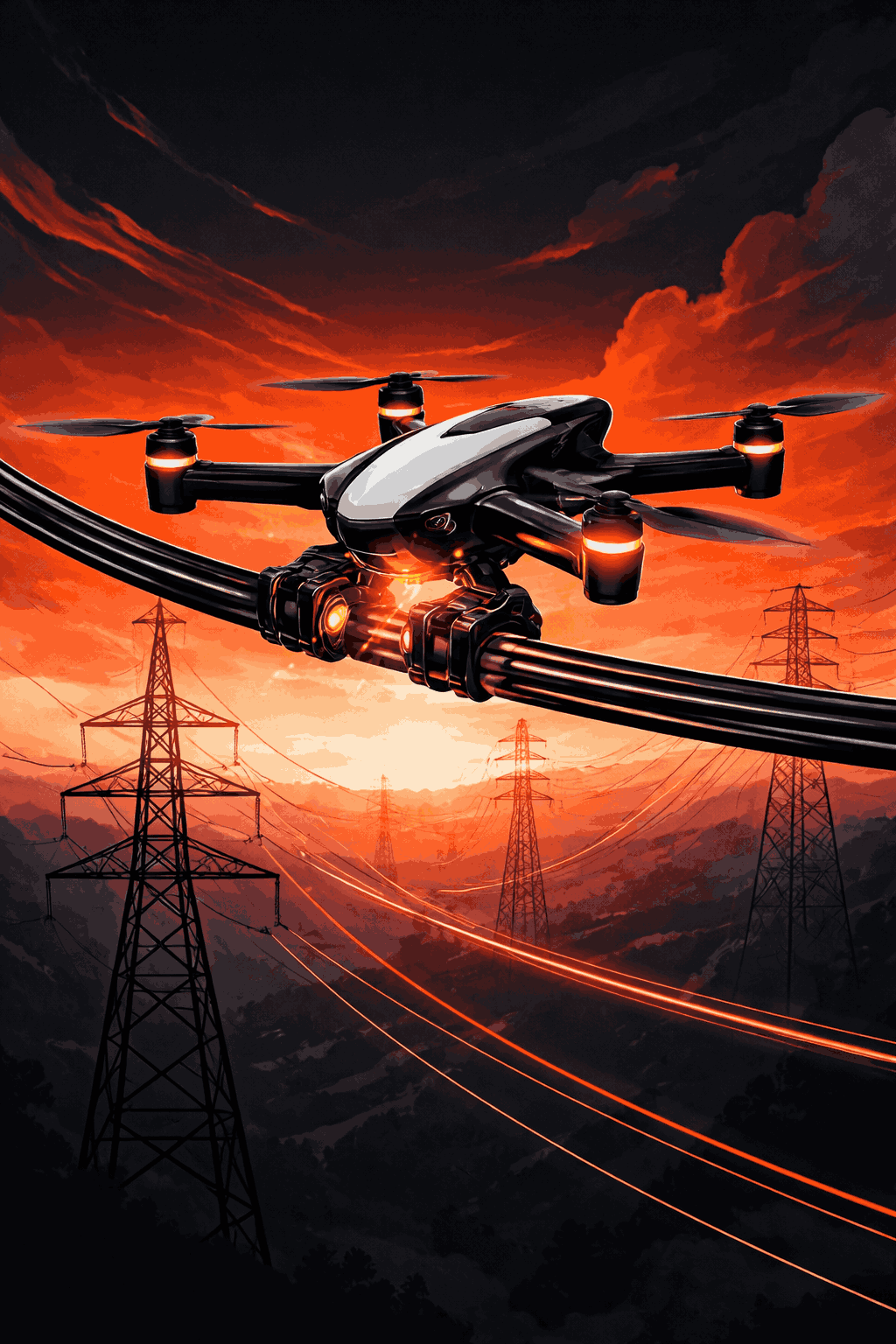
Voltair and the Rise of Self-Charging Drones
For decades, drones have promised a future of persistent aerial visibility—machines that could patrol infrastructure, monitor risk, and deliver real-time insight into the physical world. Yet one stubborn limitation has consistently grounded those ambitions: batteries. No matter how advanced the sensors or how intelligent the software, unmanned aerial vehicles have always been constrained by finite flight time, frequent battery swaps, and human intervention.
Voltair, a San Francisco–based startup founded in 2025, is challenging that constraint at a fundamental level. Rather than optimizing batteries or building more charging stations, Voltair has taken a radically different approach: drones that charge directly on transmission lines. By drawing power from the very infrastructure they inspect, Voltair’s drones can remain deployed indefinitely, unlocking what the company describes as “infinite range” for aerial inspection.
This simple but profound idea—turning power lines into charging points—has the potential to reshape not just drone operations, but the way critical infrastructure is monitored, maintained, and protected at scale.
Why Is Battery Life the Biggest Bottleneck in Autonomous UAVs?
Despite rapid progress in drone hardware, battery technology has remained a stubborn bottleneck. Most commercial drones can fly for 30 to 45 minutes before needing to return to base, land, and recharge. For infrastructure inspections, this means fragmented coverage, frequent redeployment, and heavy reliance on human operators.
In practice, battery constraints limit drones to short missions and predictable routes. They prevent continuous monitoring and make rapid response difficult during emergencies. In sectors like power utilities—where conditions can change rapidly after storms or fires—those limitations translate directly into risk.
Voltair’s founders saw this challenge not as an incremental engineering problem, but as a structural one. If drones could stay in the air—or at least remain deployed—without returning to base, the entire operational model would change. Inspection would shift from periodic and reactive to persistent and proactive.
How Does Charging on Transmission Lines Change the Game?
Voltair’s core innovation lies in enabling drones to physically interface with transmission lines and draw power directly from them. Instead of landing or swapping batteries, a Voltair drone can perch on a power line, recharge, and redeploy as needed—all without human intervention.
This approach transforms transmission infrastructure into a distributed energy network for autonomous systems. Power lines are already ubiquitous, especially in areas most vulnerable to wildfires, storms, and outages. By leveraging this existing infrastructure, Voltair avoids the need for new charging stations or ground-based logistics.
The result is a fleet of drones that can remain forward-deployed indefinitely, positioned exactly where utilities need them most. With a demonstrated range of 50 miles per deployment zone, Voltair estimates it can service roughly 90% of the U.S. land area using this model.
Why Are Power Utilities the Ideal First Customers?
Power utilities face a uniquely high-stakes operating environment. Extreme weather events—wildfires, hurricanes, ice storms, and heatwaves—are becoming more frequent, more destructive, and less predictable. Between 2000 and 2023, approximately 80% of major U.S. power outages were caused by extreme weather.
At the same time, utilities are under immense pressure to improve reliability, reduce wildfire risk, and restore power faster—all while managing aging infrastructure and rising insurance costs. In wildfire-prone regions, liability exposure has grown so severe that some utilities have faced bankruptcy or become effectively uninsurable.
Voltair positions its technology as a force multiplier for utility operations. Autonomous drone inspections can deliver more than 20 times the inspection coverage for the same cost as traditional methods. Instead of relying solely on linemen physically traveling to sites, utilities can receive immediate, high-fidelity imagery of poles, lines, and spans across vast areas.
How Can Autonomous Drones Prevent Wildfires Before They Start?
Wildfires often originate from small, hard-to-detect failures: a damaged insulator, a leaning pole, vegetation encroaching too close to energized lines. These issues frequently go unnoticed until conditions align—high winds, dry vegetation, extreme heat—and a spark becomes a catastrophe.
Voltair’s drones are designed to identify these critical maintenance concerns early. By continuously inspecting infrastructure, they can surface risks before they escalate. After extreme weather events, forward-deployed drones can rapidly patrol neighborhoods, identifying downed lines, damaged poles, or other electrical hazards that pose immediate danger to the public.
This shift from reactive inspection to continuous situational awareness represents a step change in wildfire prevention. Utilities gain visibility at the speed of the grid itself, rather than at the pace of human response.
What Has Voltair Proven So Far?
Since June, Voltair has moved quickly from concept to real-world validation. The team has successfully tested its core charging technology on live power lines, demonstrating that drones can safely and reliably draw power while deployed. They have built and flown five generations of prototypes, refining both flight and charging systems.
In parallel, Voltair has already inspected approximately 2,000 utility poles—an early but meaningful signal that the technology works outside the lab. These milestones reflect a rare combination of deep technical execution and practical field deployment, especially for a hardware-heavy startup operating in regulated environments.
Rather than waiting for perfect systems, Voltair has focused on learning directly from real infrastructure, real utilities, and real operating conditions.
Who Are the Founders Building Voltair?
Voltair’s founding team brings together deep technical expertise, operational experience, and an unusually strong alignment around critical infrastructure.
CTO and co-founder Hayden Gosch studied electrical and computer engineering at the University of Washington, with a focus on power electronics. His background includes system protection engineering at Seattle City Light and R&D work at Schweitzer Engineering Laboratories—experience that grounds Voltair’s technology in the realities of utility operations.
Co-founder and CEO Ronan Nopp developed an early obsession with remote-controlled aircraft, which evolved into advanced engineering work, including independently designing and tuning control systems for a manned eVTOL aircraft. His technical depth is matched by a strong conviction in the societal importance of infrastructure.
Avi Gotskind, co-founder and CGO, brings expertise in go-to-market strategy and government affairs, shaped by consulting work with aerospace and space companies such as Virgin Galactic, ExoAnalytic Solutions, and Amazon Kuiper. His background bridges commercial growth and regulatory navigation.
COO Warren Weissbluth studied operations research engineering at Rice University and has experience scaling NSF-funded startups, including helping raise a $1M SBIR. His operational rigor supports Voltair’s ambitions to deploy at scale.
How Does Voltair Fit Into the Future of Grid Operations?
Utilities have dramatically increased investment in grid hardening over the past two decades, nearly tripling spending from 2003 to 2023. Yet visibility into the physical grid remains fragmented and slow. Information often arrives only when a problem is physically reported, delaying prioritization and response.
Voltair envisions a future where utilities operate with real-time, on-demand visibility. A lineman or engineer could request imagery of a specific line span and receive it immediately. High-risk residential areas could be continuously monitored. Inspection would no longer be a periodic task, but a continuous data stream.
In this model, drones become an extension of the grid itself—always present, always observing, and always ready to act.
What Markets Come After Power Utilities?
While utilities are Voltair’s initial focus, the implications of self-charging drones extend far beyond the power grid. Once deployed at scale, the same technology can serve rail networks, road infrastructure, telecom towers, real estate portfolios, and other asset-heavy industries that rely on distributed physical infrastructure.
Any environment with linear assets and persistent inspection needs becomes a candidate for Voltair’s approach. Over time, the company sees itself evolving into a new infrastructure layer for data about the physical world—one that continuously captures, updates, and delivers insight at scale.
This ambition positions Voltair not just as a drone company, but as a foundational platform for physical-world intelligence.
Why Could Voltair Redefine Autonomous Infrastructure Monitoring?
Voltair’s vision challenges a long-standing assumption in robotics: that autonomy must always bow to energy constraints. By removing battery swaps from the equation, the company unlocks a class of deployments that were previously impractical or impossible.
The combination of infinite deployment, autonomous operation, and critical-infrastructure focus places Voltair at the intersection of robotics, energy, and public safety. As extreme weather accelerates and infrastructure risks intensify, the need for persistent visibility will only grow.
If Voltair succeeds, the future of infrastructure monitoring may no longer depend on how fast people can reach a problem—but on how quickly autonomous systems can see it coming.