
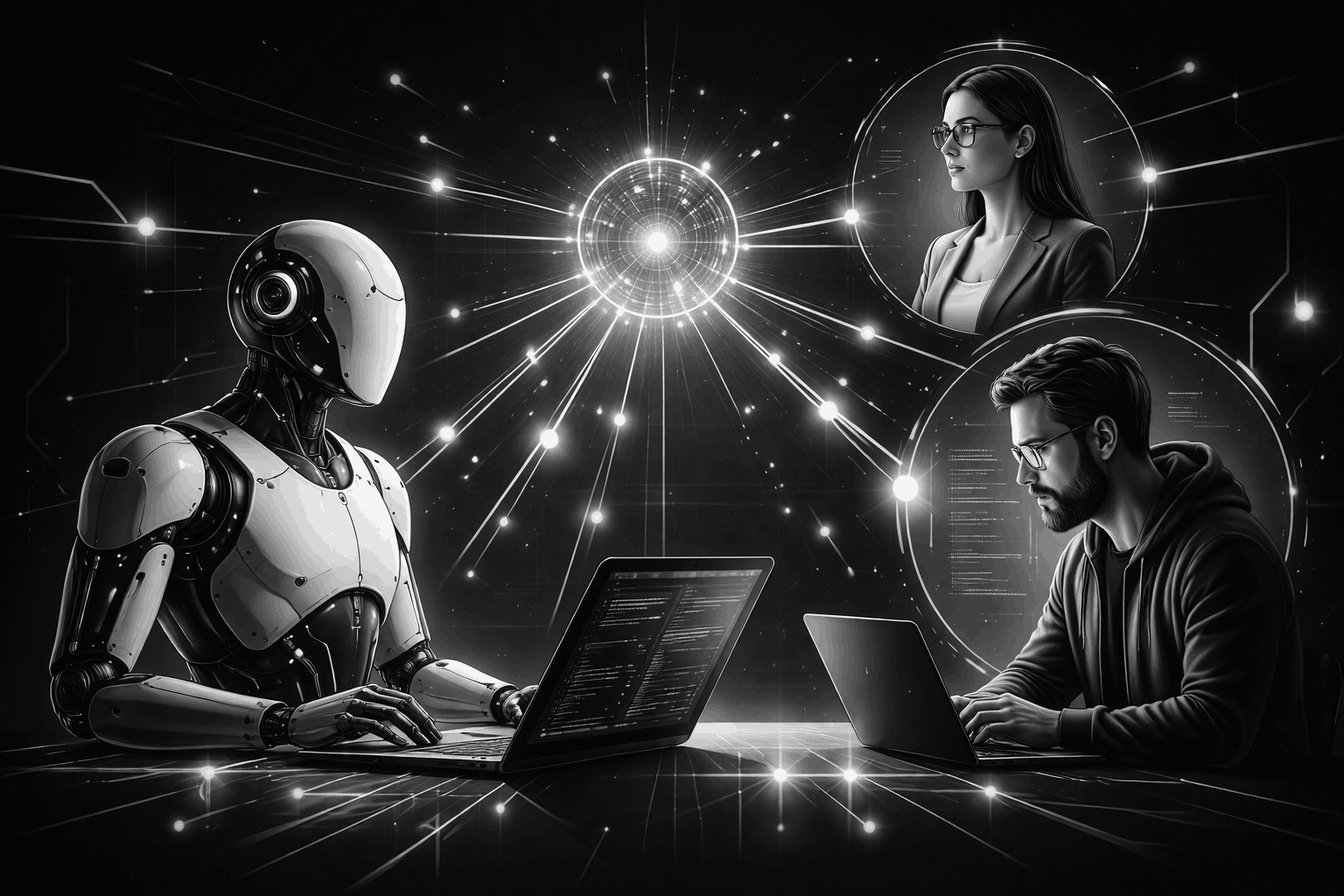
Humwork: Real-Time Help for AI Agents
In a world increasingly shaped by artificial intelligence, one limitation continues to surface: AI agents, no matter how advanced, still struggle with edge cases, nuance, and real-world judgment. This is exactly the gap that Humwork aims to close.
Founded in 2025 and based in San Francisco, Humwork introduces a new paradigm — a real-time marketplace where AI agents can instantly connect with human experts. The idea is deceptively simple yet transformative: when an AI system gets stuck, it doesn’t fail silently or rely on the user to intervene. Instead, it escalates the problem to a qualified human specialist in under 30 seconds.
This approach positions Humwork not just as a tool, but as a critical infrastructure layer for the next generation of AI-powered workflows. It acknowledges a fundamental truth: AI is powerful, but not infallible — and sometimes, a single moment of human insight can make all the difference.
What Problem Does Humwork Solve?
At first glance, modern AI agents appear incredibly capable. They can write code, generate legal drafts, design marketing campaigns, and even conduct research. But in practice, users often encounter a frustrating pattern.
An AI agent completes about 80% of a task successfully — and then breaks down.
This breakdown can take many forms:
- A coding agent loops endlessly on the same bug
- A legal assistant misinterprets a regulatory nuance
- A marketing tool produces generic, uninspired content
- A research agent hallucinates or misses critical context
For experienced professionals, these issues can often be diagnosed quickly. But for non-experts — founders, indie builders, or cross-functional teams — the failure point is much harder to identify and resolve.
This creates a bottleneck. Not because AI is ineffective, but because it lacks access to real-time human judgment at critical moments.
Humwork exists to eliminate that bottleneck.
How Does Humwork Work in Practice?
Humwork operates through a simple but powerful mechanism. It integrates directly with AI agents via MCP (Model Context Protocol), allowing them to request help autonomously.
When an AI agent detects that it is stuck, it triggers a call to Humwork. Within seconds, the platform routes the request to a verified expert in the relevant domain — whether that’s a senior engineer, lawyer, marketer, designer, or scientist.
What makes this process unique is that the expert communicates directly with the AI agent, not the user.
The expert’s input is then injected back into the agent’s context, allowing it to continue the task seamlessly. From the user’s perspective, the workflow remains uninterrupted. There is no need to switch tools, ask for help manually, or even understand what went wrong.
This creates a continuous loop:
AI execution → problem detection → human escalation → resolution → continued execution
The result is a hybrid intelligence system that combines the speed of AI with the precision of human expertise.
Why Is This Approach Different from Traditional AI Tools?
Most AI tools today operate in isolation. When they fail, the responsibility shifts to the user. The user must debug, clarify, or manually intervene — often without having the necessary expertise.
Humwork flips this model entirely.
Instead of relying on the user to bridge the gap, it embeds human expertise directly into the AI workflow. This creates a system where AI agents are no longer standalone tools but collaborative entities capable of seeking help when needed.
The concept can be compared to real-world systems already in place. For example, autonomous vehicles still rely on remote human operators for edge cases. Similarly, Humwork acts as a “human-in-the-loop” layer for AI agents across knowledge work.
This is not about replacing AI or humans — it is about orchestrating them together more effectively.
What Types of Experts Are Available on Humwork?
One of Humwork’s core strengths lies in its network of verified experts. These are not generic freelancers but domain specialists with real-world experience.
The platform includes experts across a wide range of fields:
- Senior software engineers who can debug complex systems
- Lawyers who understand regulatory frameworks and compliance
- Marketers with strong positioning and brand judgment
- Designers with a refined sense of aesthetics and usability
- Scientists and researchers with deep technical knowledge
This diversity ensures that AI agents can access the right kind of expertise depending on the task at hand.
For example:
- A coding agent stuck in a debugging loop can escalate to a senior engineer
- A legal agent unsure about contract validity can consult a lawyer
- A marketing agent can refine its output with input from a branding expert
By matching the right expert to the right problem in real time, Humwork significantly increases the reliability and quality of AI-generated outcomes.
Who Are the Founders Behind Humwork?
Humwork was founded by Rohan Datta (CTO) and Yash Goenka (CEO), two long-time collaborators with a shared background in technology and innovation.
Both founders studied at UC Berkeley and have known each other for over 16 years, giving them a strong foundation of trust and alignment.
Yash Goenka brings extensive experience as an AI engineer and entrepreneur. As a two-time founder, he has been deeply involved in building AI-driven products, including one of the early startups focused on large language models in 2021. He also holds a patent in graphene supercapacitor manufacturing, reflecting a strong technical and research-oriented mindset.
Rohan Datta complements this with a background in data science and engineering. He previously worked at MicroGrid Labs and conducted research at UC Berkeley. Notably, he built an AI voice calling platform that automated over one million minutes of phone calls — an early indication of his ability to scale AI systems in real-world environments.
Together, they bring a combination of technical depth, entrepreneurial experience, and long-term collaboration that strengthens Humwork’s vision and execution.
Why Is Timing Critical for Humwork’s Success?
The emergence of Humwork is closely tied to the rapid adoption of AI agents in everyday workflows.
Tools like coding assistants, research agents, and autonomous AI systems are becoming increasingly common. However, as their usage grows, so does the visibility of their limitations.
The “80% problem” — where AI completes most of a task but fails at the final stage — is now widely recognized among developers and builders.
This creates a unique opportunity.
Humwork enters the market at a moment when:
- AI adoption is accelerating across industries
- Users are encountering real limitations in AI performance
- The demand for hybrid human-AI workflows is increasing
By addressing a pain point that users experience daily, Humwork positions itself as an essential layer rather than an optional add-on.
How Does Humwork Impact Developers and Non-Technical Users?
For developers, Humwork offers a way to dramatically reduce time spent on debugging and problem-solving. Instead of spending 30–45 minutes diagnosing an issue, an AI agent can escalate the problem and receive expert input within minutes.
This leads to:
- Faster development cycles
- Reduced frustration
- Higher-quality outputs
For non-technical users, the impact is even more significant.
One of the biggest challenges for non-experts is not knowing when or why AI has made a mistake. This often leads to stalled projects and uncertainty.
Humwork removes this barrier by allowing AI agents to self-correct with expert guidance. This empowers non-technical users to build and execute projects without needing deep domain knowledge.
In essence, it democratizes access to expertise.
What Is the Long-Term Vision for Humwork?
Humwork’s vision extends beyond solving immediate problems. It represents a broader shift in how work will be structured in the age of AI.
The company envisions a future where:
- AI handles the majority of execution
- Humans focus on high-level decisions, judgment, and edge cases
- Collaboration between AI and humans becomes seamless and continuous
In this model, human expertise is not replaced but amplified. Experts become on-demand resources that AI systems can access whenever needed.
This could fundamentally change labor markets, creating new opportunities for knowledge workers to monetize their expertise in real time.
It also redefines the role of AI — from a standalone tool to a participant in a larger, collaborative system.
How Does Humwork Redefine the Relationship Between AI and Humans?
Perhaps the most intriguing aspect of Humwork is its philosophical implication.
The idea that “AI agents will pay humans to chat with them” may sound futuristic, but it reflects a deeper shift. Instead of humans using AI as a tool, AI becomes an active participant that seeks human input when necessary.
This reverses the traditional dynamic.
Rather than humans adapting to AI limitations, AI adapts to human expertise.
Humwork embodies this shift by creating a system where collaboration is not forced but built into the architecture.
It suggests that the future of work is not about choosing between AI and humans, but about designing systems where both can operate at their highest potential.
What Makes Humwork a Promising Startup to Watch?
As part of the Spring 2026 batch, Humwork is still an early-stage company with a small team of just two founders. However, its concept addresses a fundamental and growing need in the AI ecosystem.
Its key strengths include:
- A clear and urgent problem statement
- A simple yet powerful solution
- Strong technical founders with relevant experience
- Alignment with broader industry trends
Most importantly, Humwork is not trying to replace existing tools but to enhance them. By integrating with AI agents rather than competing against them, it positions itself as a complementary and potentially indispensable layer.
If successful, Humwork could become a standard component of AI workflows — a built-in safety net that ensures reliability, accuracy, and efficiency.
Conclusion: Is Humwork Building the Missing Layer of AI?
As AI continues to evolve, its limitations become more apparent — not as failures, but as opportunities for improvement.
Humwork identifies one of the most critical gaps: the absence of real-time human expertise at the moment it is needed most.
By enabling AI agents to connect with human experts instantly, it creates a new model of collaboration that blends automation with insight.
Whether this model becomes the standard remains to be seen. But one thing is clear: as AI takes on more responsibility, the need for human judgment will not disappear — it will simply move to the edges.
And Humwork is building the bridge to get there.