
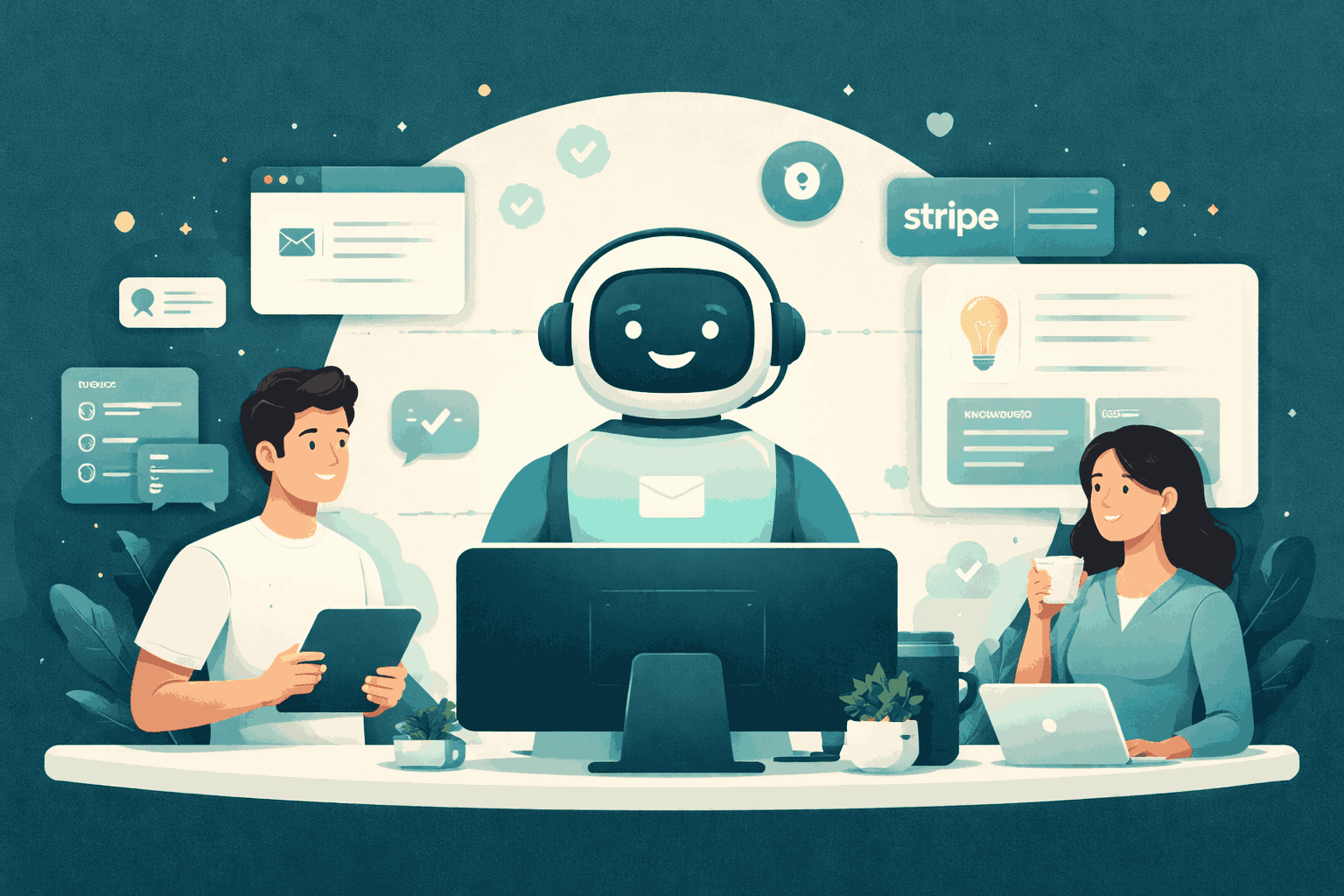
Letterbook: AI Customer Support for Startups
In a world where customer expectations are constantly rising and response times define brand perception, startups are under immense pressure to deliver fast, accurate, and personalized support. This is where Letterbook positions itself as a transformative force.
Founded in 2023 in San Francisco, Letterbook is an AI-native customer support platform built specifically for modern companies. Unlike traditional tools that were designed decades ago for large enterprise support teams, Letterbook reimagines customer service from the ground up—placing artificial intelligence at the core of every interaction.
Created by founders Dawson Chen and Ethan Hou, the platform reflects a deep understanding of the challenges faced by fast-growing startups. With a lean team of just two people, Letterbook has already begun replacing established giants like Zendesk, Freshdesk, Zoho Desk, and Intercom among companies in the Y Combinator ecosystem.
But what makes Letterbook truly stand out is not just its AI capabilities—it’s the philosophy behind its creation.
What Problem Did Letterbook Set Out to Solve?
Before building Letterbook, the founders experienced the problem firsthand. While working on their previous product, an AI personal assistant called Martin, they scaled to over 100,000 users. Growth brought success—but also chaos.
At one point, the team was receiving around 50 customer support tickets every single day. These messages came from multiple channels: emails, in-app feedback, and website forms. The content was predictable but relentless:
- “How do I use this feature?”
- “Can I get a refund?”
- “I can’t log into my account.”
Like many founders, they were forced into a reactive mode. Instead of focusing on product development or strategy, they spent hours responding to repetitive queries. Eventually, they hired a virtual assistant to keep up with demand, adding operational overhead.
To manage tickets, they turned to traditional platforms like Zendesk. However, these tools quickly revealed their limitations.
They were built for a different era—an era where large support teams, complex workflows, and hierarchical management structures were the norm. For a startup founder, they felt bloated, unintuitive, and disconnected from the actual product.
The mismatch was clear: modern startups needed modern tools.
Why Are Traditional Customer Support Tools No Longer Enough?
Customer support platforms like Zendesk or Freshdesk have long dominated the industry. But their architecture reflects assumptions that no longer hold true.
These tools were designed with the following in mind:
- Dedicated support teams with multiple layers of management
- Manual ticket triaging and assignment
- Static knowledge bases that require constant upkeep
- Heavy reliance on human agents for every interaction
For startups, this model introduces friction rather than efficiency.
Founders and small teams don’t have the luxury of hiring large support departments. They need systems that work autonomously, adapt quickly, and integrate seamlessly into their existing workflows.
Moreover, traditional tools treat AI as an add-on—something that assists humans rather than replaces repetitive tasks entirely. This results in partial automation at best, leaving teams stuck in a hybrid system that still demands significant manual effort.
Letterbook challenges this paradigm by flipping the model entirely.
How Does Letterbook Work as an AI-Native Platform?
At its core, Letterbook is built around a simple idea: AI should handle the majority of customer support work, not just assist it.
The platform integrates directly with key components of a company’s ecosystem:
- Inbox (email communication)
- Product database
- Payment systems like Stripe
- Internal knowledge bases
Once connected, Letterbook’s AI begins to operate across the entire support workflow.
Intelligent Ticket Triage
Incoming tickets are automatically categorized and prioritized. The AI understands intent, urgency, and context, ensuring that critical issues are surfaced immediately.
Automated Response Generation
For each ticket, the AI drafts a complete response. These drafts are not generic—they are tailored based on historical interactions, user data, and product knowledge.
Continuous Learning
One of Letterbook’s defining features is its ability to learn over time. Every sent response becomes part of its training data, allowing the system to improve without manual intervention.
Knowledge Base Creation
Instead of requiring teams to manually write help articles, Letterbook builds and updates a knowledge base automatically, based on recurring questions and resolved tickets.
The result is a system where the human role shifts from “doing the work” to “reviewing and approving the work.”
What Makes Letterbook Different from Other AI Support Tools?
While many platforms claim to use AI, few are truly AI-native. Letterbook distinguishes itself through several key principles.
Built for Founders, Not Managers
Traditional tools assume a structured support team. Letterbook assumes the opposite: a small, agile team where founders are directly involved in customer communication.
This influences everything from the interface to the workflow design.
End-to-End Automation
Rather than automating isolated tasks, Letterbook covers the entire lifecycle of a support ticket—from intake to resolution.
Deep Integration
By connecting directly to systems like Stripe and internal databases, the AI can provide context-aware responses. For example, it can handle refund requests or account issues without requiring manual lookup.
Iterative Improvement
Unlike static automation systems, Letterbook evolves continuously. Each interaction refines its understanding, making it more accurate over time.
Developer-Friendly Enhancements
Features like the “CMD + K” editing tool allow users to quickly refine AI-generated drafts without copying content into external tools like ChatGPT. This creates a seamless workflow within the platform itself.
How Are Startups Already Using Letterbook?
Despite being a young company, Letterbook has already gained traction among fast-growing startups, particularly within the Y Combinator network.
For these companies, the platform serves as a force multiplier.
Instead of hiring additional support staff, teams can rely on Letterbook to handle the bulk of incoming requests. This allows them to:
- Maintain high response quality without scaling headcount
- Reduce response times dramatically
- Focus on product development and growth
One founder described the impact succinctly: the AI-generated drafts save significant time and improve continuously without additional effort.
This kind of feedback highlights a key advantage—Letterbook doesn’t just reduce workload; it compounds efficiency over time.
What Does the Future of Customer Support Look Like with AI?
Letterbook represents a broader shift in how customer support is perceived.
Traditionally, support has been seen as a cost center—a necessary function that grows in proportion to user base. More users mean more tickets, which means more agents.
AI-native platforms challenge this assumption.
With systems like Letterbook, support can scale non-linearly. A small team can serve a large user base without a corresponding increase in operational complexity.
This opens up new possibilities:
- Startups can prioritize user experience without worrying about support overhead
- Founders can stay close to their users without being overwhelmed
- Companies can deliver faster, more consistent responses
In the long term, customer support may evolve into a largely autonomous function, where human involvement is reserved for edge cases and strategic decisions.
Why Could Letterbook Become a Category Leader?
The customer support space is crowded, with established players and emerging startups competing for attention. However, Letterbook’s approach gives it a unique position.
First, it is built from first principles, not legacy systems. This allows it to move faster and adapt more easily.
Second, it targets a specific audience—startups and small teams—rather than trying to serve everyone. This focus enables a more tailored product experience.
Third, it aligns with a macro trend: the rise of AI-native software. As more companies adopt AI-first tools, platforms like Letterbook are likely to gain momentum.
Finally, its simplicity is a competitive advantage. By reducing complexity and emphasizing automation, it removes barriers that often prevent teams from adopting new tools.
Is Letterbook Redefining Customer Support for the AI Era?
Letterbook is more than just another support tool—it is a reflection of how software is evolving.
By combining automation, learning, and integration into a single platform, it redefines what customer support can look like in an AI-driven world.
For startups navigating rapid growth, this shift is particularly significant. It offers a way to maintain quality, efficiency, and responsiveness without sacrificing focus on core business priorities.
As AI continues to reshape industries, platforms like Letterbook may well become the new standard—where support is not just managed, but intelligently orchestrated.
And in that future, the question will no longer be whether to use AI in customer support—but how long companies can afford not to.