
Clawvisor and the Future of Safe AI Agents
The rise of AI agents has introduced a new era of automation that resembles the early stages of the industrial revolution. Tasks that once required entire teams can now be completed in hours by a single person equipped with advanced AI tools. Agents can draft emails, manage calendars, organize files, generate reports, and even contribute to software development workflows. The promise of productivity is enormous.
Yet despite this potential, widespread adoption of AI agents remains limited outside of coding environments. The reason is simple: trust.
Many companies and individuals hesitate to give AI agents access to sensitive systems such as email inboxes, internal communication platforms, production databases, or cloud storage. The fear is not theoretical. There have already been cases where agents accidentally deleted data, performed destructive actions, or behaved unpredictably because their instructions drifted over time.
This is the environment in which Clawvisor was created. The startup focuses on solving one of the most important problems in the AI era: how to let AI agents work autonomously without giving them unrestricted control.
Based in San Francisco and launched as part of the Y Combinator Spring 2026 batch, Clawvisor positions itself as “the authorization layer for AI agents.” Its mission is to make agent-based automation safe enough for real-world use.
What Problem Is Clawvisor Trying to Solve?
The modern internet was not designed for autonomous AI agents.
Today’s systems rely heavily on OAuth permissions and API credentials. While these approaches work reasonably well for traditional software, they become dangerous when applied to nondeterministic AI systems capable of making decisions independently.
A permission such as “read Gmail inbox” sounds harmless at first. But in practice, that permission could allow an agent to either organize unread messages or extract years of sensitive communications. Similarly, giving an AI tool access to delete emails might help clean spam but could also result in an entire inbox being wiped out accidentally.
The core issue is that existing permissions are too broad.
AI agents do not operate like deterministic scripts that follow a rigid sequence of instructions. They reason dynamically, adapt to context, and may interpret goals differently over time. That flexibility is powerful, but it also creates risk.
Another challenge is approval fatigue. Many existing security systems attempt to reduce risk by asking users to approve every individual action. In reality, people quickly stop paying attention. Once users become accustomed to clicking “approve,” the security layer loses its effectiveness.
Credential exposure is another major problem. API keys often end up scattered across configuration files, development environments, messaging apps, and cloud systems. Every exposed credential increases the attack surface.
Clawvisor argues that the current approach to agent security is essentially improvisation. As AI agents become more capable, that approach becomes increasingly unsustainable.
How Does Clawvisor Work?
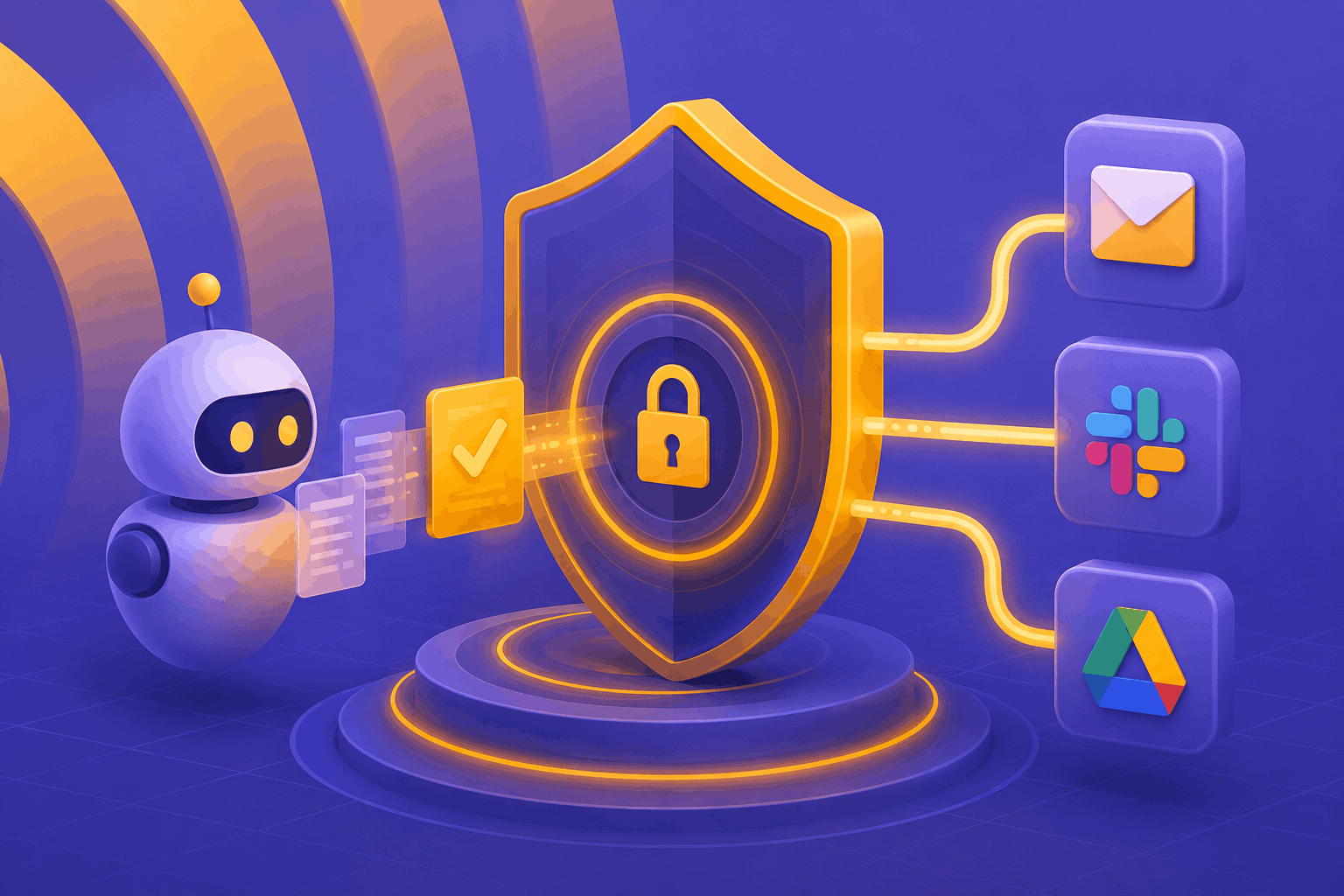
Clawvisor acts as a control layer between AI agents and external applications.
Instead of giving an agent unrestricted access to services such as Gmail, Slack, or Google Drive, the platform requires the agent to declare a specific task first. The human user reviews and approves that task a single time. From that point onward, Clawvisor continuously enforces the approved boundaries during every request the agent makes.
This changes the entire security model.
Rather than trusting the AI agent completely, users trust the policy enforcement system surrounding it.
For example, if an agent is approved to “check today’s calendar,” Clawvisor monitors every related request. If the agent suddenly attempts to retrieve five years of historical calendar data instead of the current day’s schedule, the request is blocked automatically.
This creates context-aware restrictions rather than broad permissions.
The platform also keeps credentials hidden from the agent itself. API keys and sensitive authentication tokens remain stored securely in a protected vault. The AI agent never directly sees or handles them.
In practical terms, this means an agent can perform useful work without possessing the actual “keys to the kingdom.”
Why Is Task-Level Authorization Important?
One of Clawvisor’s central ideas is that approvals should happen at the task level rather than the action level.
Traditional systems often interrupt users constantly. Every email draft, every file access request, and every API call may require manual approval. While this may appear secure on paper, it creates an exhausting user experience.
Humans eventually stop evaluating requests carefully.
Clawvisor attempts to solve this by allowing users to approve an overall objective instead of every microscopic action involved in completing it.
For example:
- “Summarize today’s unread emails.”
- “Prepare a report from this spreadsheet.”
- “Schedule meetings for next week.”
- “Review pull requests in this repository.”
Once approved, the agent can execute the necessary subtasks within clearly defined boundaries.
This model balances usability and security in a way that many earlier AI systems struggled to achieve.
The startup also incorporates risk scoring into approvals. Higher-risk tasks can receive additional scrutiny, while lower-risk tasks can move more fluidly through workflows. This approach mirrors modern fraud detection and trust-and-safety systems used in financial services and large-scale consumer platforms.
How Does Clawvisor Prevent AI Agents From Going Rogue?
The phrase “going rogue” has become increasingly common in discussions about autonomous AI systems. In most cases, the issue is not malicious intent but rather instruction drift.
Long-running AI agents can slowly deviate from their original goals as they process more context, interpret ambiguous instructions, or encounter unexpected scenarios.
Clawvisor attempts to mitigate this risk through real-time policy enforcement.
Every request generated by an agent is evaluated against the original approved task. If the request exceeds the permitted scope, the system blocks it immediately.
The platform also introduces contextual guardrails. Agents can only interact with information they have already retrieved legitimately during the approved workflow. This reduces the likelihood of unrestricted data exploration or accidental exposure of unrelated content.
In addition, Clawvisor provides a complete audit trail for all actions and decisions. Every request, approval, rejection, and enforcement action is logged. This visibility is especially important for organizations operating in regulated industries or security-sensitive environments.
Companies increasingly need systems that can demonstrate accountability and compliance when AI tools are involved in operational workflows.
Why Does Clawvisor’s Timing Matter?
Clawvisor is entering the market at a moment when AI agents are rapidly evolving from experimental tools into practical workplace systems.
Coding agents have already demonstrated substantial productivity gains. Tools capable of generating software, debugging code, and automating repetitive engineering tasks are becoming mainstream among developers.
The next phase is broader operational automation.
Businesses want agents capable of handling customer support, finance operations, recruiting workflows, project management, internal communications, and research tasks. However, these areas involve sensitive information and high operational risk.
Without reliable authorization infrastructure, many enterprises will hesitate to adopt fully autonomous workflows.
This creates an opportunity for startups focused on trust, governance, and safety.
Rather than competing directly with AI model providers, Clawvisor operates at the infrastructure layer surrounding agents. Its value comes from enabling safe adoption rather than building the underlying models themselves.
This positioning may prove strategically important as the AI ecosystem matures.
Who Is Behind Clawvisor?
Clawvisor was founded by Eric Levine, an entrepreneur and engineer with significant experience in trust, identity verification, and security infrastructure.
Before launching Clawvisor, Levine co-founded Berbix, a company focused on identity verification technology. Berbix became known for building advanced systems designed to prevent fraud and establish digital trust online. In 2023, the company was acquired by Socure in a deal reportedly valued at approximately $70 million.
Prior to Berbix, Levine worked at Airbnb, where he led Trust & Safety engineering efforts. His work involved building systems capable of detecting bad actors and preventing harmful activity before it could impact users.
This background is highly relevant to Clawvisor’s mission.
The startup is fundamentally about managing trust boundaries between humans, AI systems, and sensitive digital infrastructure. Levine’s prior experience with fraud prevention, risk analysis, and large-scale trust systems appears directly aligned with the challenges autonomous AI introduces.
In many ways, Clawvisor can be viewed as an extension of the trust-and-safety principles that became essential during the growth of internet platforms over the last decade.
How Could Clawvisor Influence the Future of AI Adoption?
The future of AI agents likely depends less on raw intelligence and more on reliability, governance, and control.
Many foundational AI capabilities already exist. Large language models can reason, write, summarize, code, and interact with software systems. The limiting factor is often whether organizations feel safe deploying them in high-stakes environments.
Clawvisor addresses that missing layer of trust.
If the startup succeeds, it could help transform AI agents from experimental assistants into dependable operational tools integrated across everyday business systems.
This would have implications far beyond productivity gains. It could change how companies structure teams, manage workflows, and allocate human attention.
Instead of spending hours on repetitive operational tasks, workers could supervise AI systems that execute those tasks within carefully controlled boundaries.
The concept resembles the evolution of cloud computing. Early cloud adoption faced skepticism around security and governance. Over time, infrastructure layers emerged that made organizations comfortable trusting external systems with critical workloads.
AI agents may follow a similar trajectory.
Companies like Clawvisor are attempting to build the trust infrastructure necessary for that transition.
Could Authorization Become the Most Important Layer in Agentic AI?
As AI systems gain autonomy, authorization may become one of the defining technical challenges of the decade.
The issue is no longer whether AI agents can perform tasks. Increasingly, they can.
The real question is whether they can be trusted to operate safely at scale.
Clawvisor’s thesis is that trust cannot depend solely on the intelligence or reliability of the model itself. Instead, it must come from strong external enforcement systems that constrain behavior, monitor actions, and prevent dangerous deviations.
This philosophy shifts AI safety from abstract theoretical debates into practical infrastructure.
Rather than waiting for perfectly aligned AI systems, Clawvisor focuses on building mechanisms that reduce risk in the real world today.
As businesses continue exploring agent-driven workflows, platforms that provide oversight, policy enforcement, auditing, and secure authorization may become as important as the agents themselves.
For now, Clawvisor remains an early-stage startup with a small team and an ambitious vision. But the problem it is addressing sits at the center of one of the most significant technological transitions currently underway.
If autonomous AI agents are going to become part of everyday life, companies will need systems that allow people to benefit from automation without surrendering control.
That is the future Clawvisor is attempting to build.